One-Liner Wednesday: autumn dogwood

Thought I’d share fall photos of the Kousa dogwood at our house and its fruit, after showing its greenery earlier.

Join us for Linda’s One-Liner Wednesdays! Find out more here: https://lindaghill.com/2025/11/05/one-liner-wednesday-this-is-why/

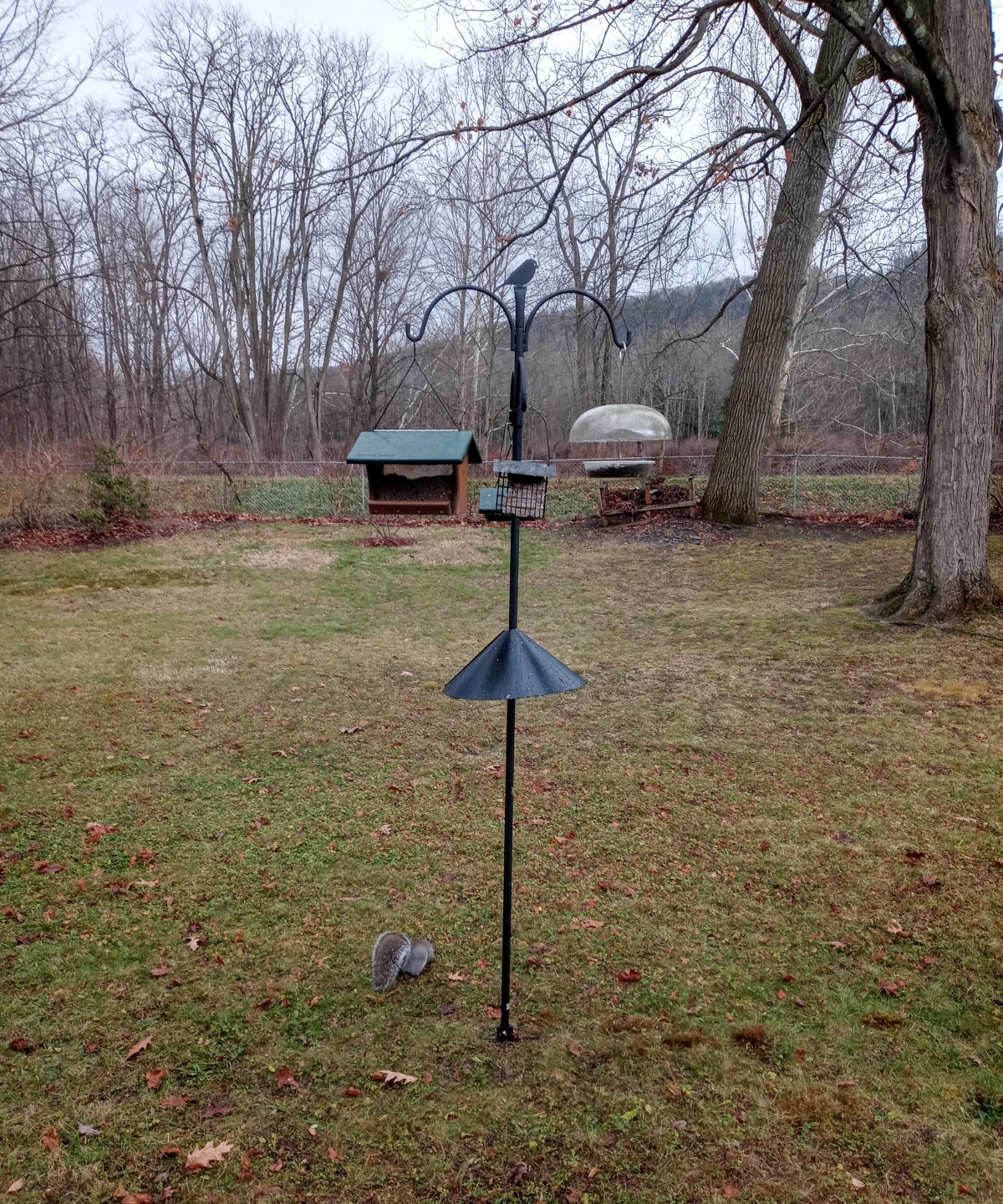
One-Liner Wednesday: back to bird feeding

We are finally able to go back to feeding the birds in our backyard, although putting out just seed and not suet in hopes of not attracting bears. (Photo is from a few years ago.)

Join us for Linda’s One-Liner Wednesdays! Find out more here: https://lindaghill.com/2024/11/13/one-liner-wednesday-motherhood/

just because


B took this in our backyard last month, just as the fog was lifting. I wanted to share some rays of sunshine with all of you.

One-Liner Wednesday: woodpecker

A family of woodpeckers turned our house into theirs.

Join us for Linda’s One-Liner Wednesdays! Find out more here: https://lindaghill.com/2024/05/15/one-liner-wednesday-ten-years-and-two-months/

One-Liner Wednesday: household COVID update

Spouse B seems to be through most of his symptoms on Day 5, but will continue to mask and isolate at home, while daughter T and I are continuing to be symptom free and are masking at home when we are with each other and when we have to go out in public. (COVID Photo by Martin Sanchez on Unsplash)
*****
This update brought to you as part of Linda’s One-Liner Wednesdays! Join us in these brief (usually fun or inspirational) posts! Find out more here: https://lindaghill.com/2023/11/15/one-liner-wednesday-worried-who-me/

out of luck

I’m sad to report that, despite our best efforts, we finally have a case of COVID-19 in the house.

My spouse B tested positive yesterday. We think he was exposed at an in-person work event on Wednesday.

We are taking precautions to isolate from each other but daughter T and I were both exposed to B before he developed symptoms when he was probably infectious, so it’s a waiting game at this point. We’ll be testing before going out in public and masking when we do to avoid infecting anyone else, in case we are pre-symptomatic.

So far, B has had fever and symptoms similar to a bad cold. Our primary care practice wants to hold off on prescribing Paxlovid but will if his condition worsens over the next couple of days.

I knew our luck would run out one day but I’m upset and worried to have COVID in the house. Because I’ve been reading about it and observing the twists and turns in its history since the beginning, I know that things sometimes go very badly, even in someone who is healthy and up-to-date on vaccines, so…

Photo by Martin Sanchez on Unsplash

Poem on The Purposeful Mayonnaise

My poem “Grandpa’s pipe smoke lingers on the stoop” has just been published in Issue 3.2 of The Purposeful Mayonnaise, a Canadian-based bimonthly literary and art journal-platform. The theme for this issue is “Home.” It’s available for free download at the link above. Make sure to view all the amazing art and writing, including an interview!

My poem is part of my currently unpublished full-length collection that centers around the North Adams area and my family’s experiences there. I wrote it during the 2019 Boiler House Poets Collective residency at The Studios at MASS MoCA.

Its original title was “122 State Street.” For those of you who know North Adams and who would like to be oriented physically, the location is right before heading over Hadley Overpass toward Main Street.

This poem is about my maternal grandparents’ home when I was in the lower grades of primary school, over fifty years ago now. Remember that your comments are always welcome here at Top of JC’s Mind.

tree drama

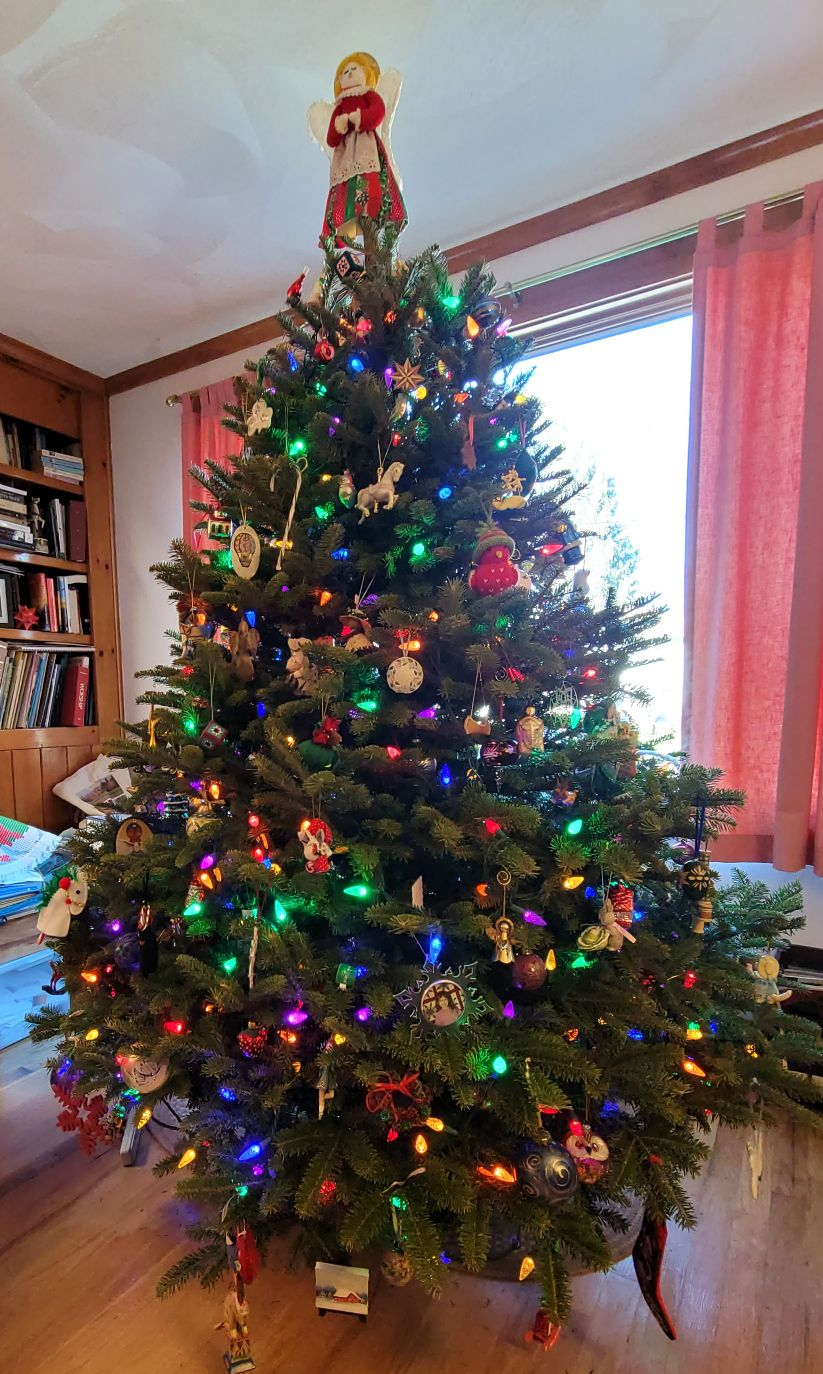
A few hours after I wrote this post, B, T, and I were watching television when there was a horrible crash behind us. Our newly decorated tree had tipped over! Apparently, the bolts that hold it in the stand weren’t tightened quite enough.

We all sprang into action! B pulled the tree off the floor, T ran to get towels for the water, I pulled back the carpet so it would’t get soaked, T and I got towels down on the wood floor, and T and I held the tree in position so B could secure the bolts.

We got water back in the stand and re-positioned the ornaments and lights which had dislodged. We were fortunate that we only lost three small glass ornaments, none of them heirlooms. There was quite a lot of sweeping up to do, with needles and broken glass strewn about the floor.

Now, the tree looks almost like this again! (Besides the three that broke, a few others are in different places now.)

build back smarter

The United States is having a rough couple of weeks on the hurricane front. First, Fiona caused major damage in Puerto Rico, and now, Ian has cut a huge swath of destruction across Florida and is making a second landfall in South Carolina.

There have been massive flooding, wind damage, and major infrastructure impacts, including roads, bridges, and electrical, water, and communication systems. Sadly, there have also been injuries and deaths attributed to the storms and their aftermath.

Aid is being rendered by governments at all levels, by utilities, by charitable organizations, and by volunteers.

After the immediate emergency needs are met, attention will turn to rebuilding.

The first question to ask is “Should we?” There are places where the answer may be “No.” I’m thinking about places like barrier islands and directly on shorelines that are geologically unsuitable, being vulnerable to both storms and sea level rise. Further, the sand that characterizes these areas is meant to move and their natural structure serves to help protect inland areas from the worst of the storm surge and winds. Building there is asking for trouble and re-building there is setting up for losses in the future. With stronger and more frequent storms forecast due to global warming, it may be wisest at this point for government and insurers to buy out property owners in these vulnerable places so that homes and businesses can move to safer locations inland.

In other places, rebuilding may be possible but with much stricter requirements. For example, buildings can be elevated so that flood water can rise beneath them without damaging living space. Structures can be designed to be wind-resistant so roofs don’t blow off during storms. Mobile homes, unless they really are mobile, i.e. on wheels so they can be easily relocated away from danger, should not be allowed at all in storm zones.

It’s vital to rebuild infrastructure with resilience in mind. Five years ago, hurricane Maria destroyed the power grid in Puerto Rico. It was still fragile when Fiona hit but locations that had switched to solar power with battery backup were able to keep their power on. Tropical coastlines are great places for solar power and also for offshore wind, which could have the added benefit of reducing wind speeds from storms.

These changes won’t be easy but they are necessary. The alternative is to continue the cycle of destruction and expensive rebuilding over and over again.

Some of you may be thinking that I don’t understand the difficulty and trauma of leaving a beloved location instead of trying to rebuild there, but I have seen it up close in my town. After the last two record floods of the Susquehanna in 2006 and 2011, many people here faced the decision to rebuild in the same place, perhaps with elevation, or move elsewhere. If people took buyouts, the sites of their former homes were converted to greenspace. There are two neighborhoods near me that are dotted with these lots that used to be homes and yards.

My family lives with the realization that our home, on which we carry flood insurance even though we are not technically in a flood zone, could be impacted in the next record flood. (We are just a few blocks from places that flooded last time.) Depending on the damage incurred, we could be faced with the same decision to take a buyout or repair and elevate our home. It’s painful to think about and I don’t know which we’d choose.

We’ve been here for over 35 years. It would be hard to leave the neighborhood. I do know, though, that we wouldn’t ignore reality/risks and try to rebuild as we are now.

I opt for safety over sentiment.

inflation and energy

As the United States Senate passed a major budget reconciliation bill dealing with climate change, energy sources, health care, and corporate taxes this weekend, there has been a lot of public whining from Republicans and industry, saying that the bill will increase, not lower inflation.

Judging from my family’s experience, the bill will lower inflation by decreasing energy costs.

As regular readers may recall, my household has spent years in efforts to reduce our carbon footprint. We have electrified everything in our home, including a geothermal heating/cooling system. We reduced our demand by increasing our insulation and installing LED lighting. We drive our fully electric Chevy Bolt for local driving. (For trips over 200 miles, we drive our plug-in hybrid Chrysler Pacifica, which gets better mileage in gasoline mode than the non-hybrid version.) We own panels in a solar farm because our home was not a good candidate for rooftop panels.

So, this summer, our monthly electricity bill is $17.35, which is the delivery charge from our electric utility. This covers all our household lighting, cooling, laundry, electronics, water heating, etc. plus all our local and short-trip driving.

Meanwhile, many households are burdened with paying $100 to fill their gas tank for the week, plus the cost of their household electricity and methane, propane, or other fuels that they use for heating water, cooking, drying clothes, etc.

A large share of recent inflation is due to increased fossil fuel prices. For our family, that has been felt mostly in the higher cost of food, which is largely driven by the expense of fuel.

I realize that not every household will be able to follow our exact path to be nearly free of fossil fuels but the Inflation Reduction Act just passed by the Senate, which is expected to be passed by the House and sent to President Biden to sign into law later this week, will go a long way to reducing expensive fossil fuel use for residents. As more renewable power comes on line, electricity costs will come down because it is cheaper to produce than fossil fuel electricity. There are rebates targeted at lower-to-middle income folks to help move to electric vehicles, which are much cheaper to run than internal combustion engines. As battery costs have fallen, electric cars are already around the same price as some conventional cars/trucks, so the rebates may make them cheaper to buy.

It’s true that inflation will not suddenly disappear, but this bill has provisions that will bring it down and will help to decrease future inflation spikes by removing inherently volatile fossil fuel prices from the center of our economy. The bill is projected to save average households about $500/year in energy costs. Some households, such as ours, will be able to save much more than that.

So, let’s get this done and enacted! The sooner we do, the sooner it will help people and the planet.