another debate

Tonight, there will be a debate among the candidates for the Democratic nomination for the US presidency.

Martin O’Malley, former governor of Maryland, has failed to gain traction with voters, so most eyes will be fixed on Vermont Senator Bernie Sanders and former Secretary of State, New York Senator, and First Lady Hillary Clinton.

Sanders and Clinton are close in the public opinion polls in both Iowa and New Hampshire, the first two states to award delegates for the nominating convention.

There is one aspect of the race for the nomination and the general election that I feel is important but that isn’t being discussed much in the press. While Sen. Sanders is running for the Democratic nomination, he is not a Democrat himself. While in Congress, he has caucused with the Democrats, while retaining his status as an Independent.

Among the US electorate, there are more voters who are independent, that is, not registered with any political party, than there are voters who are registered Democrats or Republicans.

In some states, such as my native Massachusetts, independents can decide on the day of the primary which party ballot to vote; in others, such as my current home state New York, only registered members of the party are allowed to vote in that party’s primary.

I am an independent, so ineligible to vote in the primary, which is especially vexing this year as I am a supporter of Senator Sanders, but will not be able to vote for him in the New York primary.

The story that many in the media are missing is the possible impact of independent voters in the race.  In states with open primaries, Senator Sanders may draw significant support from progressive independents, while he may poll more poorly in states with closed primaries where only registered Democrats are allowed to vote.

The interesting thing to study is whether how well Sanders polls versus potential Republican rivals is due to his increased appeal to Independent voters. If so, it is something for the Democrats to keep in mind in choosing a candidate who can appeal to and energize the most voters in the general election.

In the United States, turnout is the most important factor in elections. A candidate who can marshal not only the party that nominated him/her but also the independents is the one who will win the election.
*****
This post is part of Linda’s Just Jot It January. Join us! First, visit here:   http://lindaghill.com/2016/01/17/just-jot-it-january-17th-collection/

JJJ 2016

To find the rules for Just Jot It January, click here and join in today.

Gloria Steinem, Hillary Clinton, and I

A friend posted a link to this article:  http://www.theguardian.com/us-news/2015/oct/19/gloria-steinem-hillary-clinton-white-house?CMP=share_btn_fb on Facebook a few days ago. Gloria Steinem writes about her reactions to Hillary Clinton as she ran for New York Senator and for the Democratic nomination for president and about some other women’s reactions which were not as positive as hers. Her article inspired me to add my own viewpoint.

When Bill Clinton was running for the Democratic nomination for the first time, he was in trouble for reports of him having affairs.  Bill and Hillary appeared for a joint interview on 60 Minutes. I remember thinking that the wrong person was running for president. While Bill is undoubtedly the more charismatic, Hillary struck me as being the more intelligent of the two. Being first lady of Arkansas and then of the United States didn’t really give her the opportunities to reach her full capacity in service and in leadership.

I appreciated that when she ran for Senate in New York she did a lot of listening and I was proud to be able to vote for her. She did a good job as Senator and gained valuable experience. When she ran for the presidential nomination in 2008, I felt she was the stronger candidate than Barack Obama because she had more experience, as Steinem notes in her piece. Because I am an independent and New York has a closed primary system, I wasn’t allowed to vote, though.

The experience Hillary gained as Secretary of State in the Obama administration makes her even more experienced as a candidate now. I do have a problem, though. Because she had to spend so much of her time in the public eye supporting someone else’s vision and having to play the game that women often have to play to prove that they are “tough” enough to participate in predominantly male environments, it is hard to pin down what policies she believes in herself, as opposed to positions she had to take on for other reasons.

While I am excited by the prospect of a woman president and believe that Hillary will gain the Democratic nomination and the presidency, at the moment I am supporting fellow independent Senator Bernie Sanders of Vermont. Bernie’s progressive views most closely match my own and he has been amazingly consistent in his vision over the decades. I believe his candidacy has been good for Hillary, helping her to articulate her own progressive views that had gotten buried in the years of having to follow the lead of her husband, her party leadership, and President Obama as a member of his Cabinet.

I do deplore the amount of snark – and worse – that women candidates have to endure. As Steinem points out, some of the disapproval comes from other women, where it is often a reflection of dissatisfaction with a woman’s own life rather than an actual disagreement with the candidate. Further, Clinton has to contend with actual hatred directed at her by some partisans. No Congressional committee would have questioned Sec. Colin Powell for eleven hours as the House Benghazi committee did this past week with Clinton. I agree with Steinem that, had I faced the choice to run for Senate that Hillary did, I would have said no. Running for president – twice – is even more punishing.

It feels odd, as a feminist, not to be on Hillary’s bandwagon yet. I am again faced with the situation that I don’t have a vote until the general election, when I fully expect that I will be casting my vote for Hillary Clinton and her running mate. Meanwhile, I will back the candidate whose positions I share most closely, Bernie Sanders.

Government Gridlock: Theme and Variations

Before the Nov. 4 US elections, there was a lot of speculation about whether or not the Republicans would take a majority of the Senate seats. I thought about weighing in, but didn’t because I realized it wouldn’t really matter. We would just be swapping one flavor of legislative gridlock for another.

A primer of the US system, for those who don’t live in the United States:  Legislation must be passed by the majority of both houses of Congress, The House of Representatives and the Senate. (If each houses passes a different version of a bill, a conference committee drafts a compromise version for approval.) The President can sign the legislation into law or veto it. In the case of a veto, the bill doesn’t become law unless a two-thirds majority of both houses of Congress vote to override the veto. The other important word to know is filibuster. In the Senate, 60 of 100 votes are needed to move a bill forward for a vote. This was originally designed as a way for minority views to be heard and was time-limited by the length of time that Senators could speak, but has morphed into a tool to block any legislation for which there are not 60 votes in favor, even if it has majority support of 51-59 votes.

Congress has been gridlocked for most of President Obama’s time in office. There was a brief period in the beginning of his presidency with a Democratic majority in the House and a filibuster-proof majority in the Senate. This was when the stimulus bill and the Affordable Care Act were passed.  The Republicans had vowed not to support anything the President wanted, but they could not stop legislation, so there was no gridlock then, even though the Republicans were refusing to co-operate in governing.

Within months, due to the death of Senator Kennedy and a special election that went to a Republican, the Democrats lost the ability to break a filibuster in the Senate and the first flavor of gridlock began. Instead of the rare use of the filibuster that had been the case for the 200+ year history of the Senate, the Republicans began filibustering almost every piece of legislation and many nominations for judgeships and executive branch appointees. The Democratic majority House was still passing bills, but the Democratic majority Senate could not get them to the floor because the 41 Republicans kept filibustering.

Next, the Republicans, thanks largely to gerrymandering of Congressional districts within states, took the majority in the House, which began phase two of gridlock, where the House passed dozens of bills that were never going to be taken up in the Senate, like voting to repeal the Affordable Care Act fifty times, while the Senate Republicans filibustered almost everything that was proposed. When there was a rare instance of bipartisanship, such as the Senate passage of comprehensive immigration reform, the Republicans in the House wouldn’t even bring it up for a vote. Meanwhile, the filibuster in the Senate blocked nominations for key posts, so we faced the ebola situation without a surgeon general to lead and co-ordinate the efforts and the debacle with Russia and Ukraine without a US ambassador to Russia.

So, with the electorate already frustrated with gridlock and disgusted that this Congress is about to break the shameful record set by the last Congress for least number of laws passed, we held elections last week. Turnout was 36.3% of eligible voters, the lowest in seventy-two years. In many Congressional districts, including mine, an incumbent was running unopposed. The Republicans will hold a majority in both houses of Congress.

One could hope that the Republicans would now decide to co-operate with the Democrats in governing, as many past Congresses have done when one party had majorities in Congress with a sitting president from the other party.

Unfortunately, such hope is not warranted.

We are just going to move on to the next flavor of gridlock, although this one will probably have a bit more spice to it. Some legislation that the Democrats find particularly objectionable will be filibustered in the Senate. Other legislation may pass by both houses on party-line votes, get vetoed by the president, and then die because there will not be a two-thirds majority to override the veto.

The mystery lies in what happens after that political theater is over. Will the Republicans, having satisfied their base with their initial votes, actually work to craft a bipartisan solution which could pass both houses and be signed by the president?

I wish I could say yes, but recent Republican party history and current rhetoric do not give cause for hope.

I voted for myself

 
I got back from my polling place, which had a steady stream of citizens coming in to vote. Yay, Democracy!
Well, sort of yay…
Because of the gerrymandering of Congressional districts, there was only one candidate on the ballot for Congress, an incumbent who is part of the problem of Washington gridlock and with whom I fundamentally disagree on a host of important issues.
Despite his being the only name on the ballot, I could not bring myself to vote for him. I also did not want to leave that column of the ballot blank, so I decided to vote for myself.
I shared this plan with my Facebook friends yesterday, so I may get a few other write-in votes, too.
Here’s hoping that in two years I will have more choices on the ballot.

On being a NY fracktivist

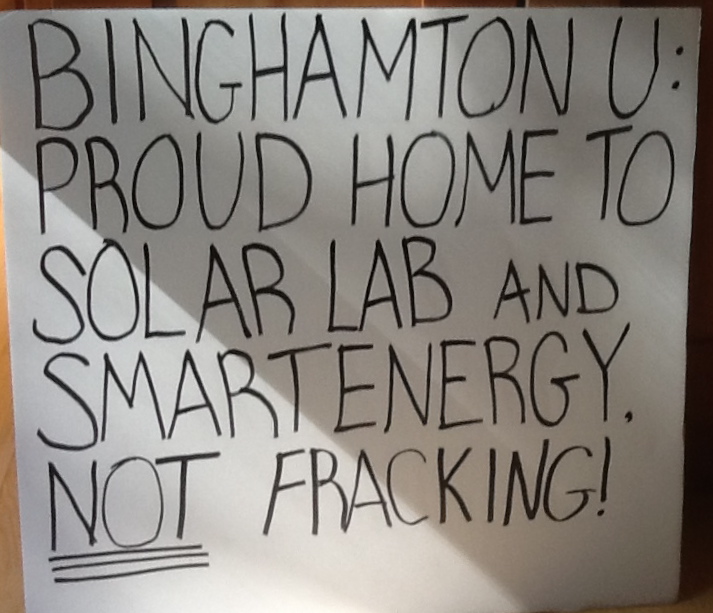
My sign - side one
My sign – side one

I spend a fair, some might say inordinate, amount of time on the fight to keep fracking out of New York State and to limit and end its use elsewhere. I frequently write comments on articles about it, a small fraction of which I share here at Top of JC’s Mind or on Facebook.  (For those who don’t know, fracking is the shorthand name for a process that extracts liquid and gaseous hydrocarbons from rock by using a mix of water, sand, and chemicals at extremely high pressure to fracture the rock.  Tons of information about environmental and health effects are available here: http://concernedhealthny.org/wp-content/uploads/2014/07/CHPNY-Fracking-Compendium.pdf )

I also attend events, rallies, and meetings when I can.  Fracktivists (or fractivists, a spelling I don’t use as often because people sometimes glance at it and read it as fascists, which takes their mind in a totally wrong direction) in New York have taken to showing up with signs asking for a ban on fracking whenever Governor Cuomo appears in public, usually on his way to an event that has restricted access.  This bird-dogging, as it is called, has become even more important in the run-up to the November election.

While Cuomo claimed that, as governor, he would keep an open public calendar, he has taken to keeping his schedule secret until the last possible moment. Thus, it wasn’t until late Wednesday evening that we got word that the governor would be arriving at Binghamton University at 11:00 AM Thursday.  Isaac, our intrepid community organizer – did you know that community organizers can become president some day? – quickly got the word out and about twenty of us showed up, signs in hand, to greet the governor’s motorcade and chant “Ban Fracking Now!”

As important as it is for Cuomo to see us wherever he goes, it is equally important that members of the press talk to us.  We had three television stations, public broadcasting radio, and the local newspaper taking interviews.  We were happy that Dr. Sandra Steingraber was among our number that day.  She is a biologist and public health expert who is currently at Ithaca College, a nationally and internationally known expert in toxic impacts of industrial pollution who is spending the lion’s share of her time and effort these days in the fight against fracking.  All the media outlets interviewed her.  Here is a sample of coverage that we received:  http://www.binghamtonhomepage.com/story/d/story/fractivists-protest-gov-cuomos-visit/34621/XNJzJy-Dkk-O7Wrr4WZOig.

We have been at this for several years and may be at it for several more.  It’s tough to fight an industry that spreads its huge wealth around to politicians to keep our country using polluting, climate-killing fossil fuels, but we have to keep fighting because it is so important to our present and future.

My sign - side two
My sign – side two

school district election day

Today, across New York State, voters are heading to the polls for school district elections. For some reason I have never been able to ascertain, school budgets are the only ones that are voted on directly in New York. Unfortunately, sometimes this means that school budgets fail as a general statement against taxes, forcing second votes on revised budgets or austerity budgets that cut all extracurriculars and all-but-bare-bones transportation.

This year, there has been an unusual amount of advertising to pass the school budget. I think it is to convince people not to use the budget vote as an opportunity to take out their frustration with the contentious rollout of common core standards in the state. For the record, I no longer have school-aged children in my household, so I haven’t experienced common core directly in my family. I do support the concept of common core, to cover fewer topics in a school year, but in greater depth, in contrast to the current trend toward a mile wide but an inch deep approach. New York State’s curriculum has long been infected with survey-itis. For example, in the social studies curriculum, a survey of US history is taught in fifth grade, again as a two-year sequence in seventh and eighth grades, and then again as a one year Regents course in high school, locally usually taken in 11th grade. Because so much time is devoted to rushing through large amounts of material, there isn’t time to engage in in-depth analysis of any time period or theme. When I was in high school in Massachusetts several decades ago, we had options for semester-long US history courses in Civil War and Reconstruction, Minorities in America, Presidential Greatness, or several other options. Already expected to have an overview of our country’s history, we were able to develop deeper understanding of the hows and whys of history, which also helped to inform our lives as active citizens.

The upset over the implementation of common core seems to mirror two statewide changes that happened during my children’s school careers, the ending of local high school diplomas in favor of more rigorous Regents diplomas for all graduates and reform of state-wide tests in fourth and eighth grades and high school Regent exams. It also mirrors the transition to a new high school honors program on the local level. The root of the problems with all these changes was not that the final goals, but the transition itself, in which students are tested in the new framework without the benefit of the years of preparatory study that is in place when the transition is complete, resulting in lower test scores as these students catch up to the new standards. It seems that the same mechanism is happening with the transition to common core.

The other oddity of this election locally is that we have eight candidates running for four board of education seats. Given that candidates often run unopposed or with only one more candidate than seats available, this year is a hot contest. Even more unusual, there is a group of four being presented almost as a slate, advertised together in mailings, on yard signs, and in hand-delivered fliers, and endorsed by the local teachers’ union.

Voting is from 12-9 PM today at the local elementary schools. It will be interesting to see how this all turns out.

UPDATE:  The budget passed by a wide margin. All four of the candidates endorsed by the teachers’ union were elected; the two incumbents who were running for re-election got only 50-60% of the voting totals of the successful candidates.