No CO2 Fracking in NY!

I’m pleased to report that, over the weekend, New York Governor Kathy Hochul finally signed the bill adding carbon dioxide to the existing ban on hydraulic fracturing (fracking) in the state. We recently observed the tenth anniversary of the ban.

You can read more about the bill and how important it is to keeping us safe here.

A huge thank you to State Senator Lea Webb, sponsor of the bill in the Senate, and Assemblymember Anna Kelles, sponsor in the Assembly. Thanks also to Donna Lupardo, my Assemblymember, who was a co-sponsor. I will always be grateful to the large coalition of scientists, experts, Indigenous Nations, environmental organizations, and concerned individuals who have been at work for years on this issue for the good of our health, our environment, and our climate.

Broome County, where I live, would have been among the first targeted with this dangerous experiment to use supercritical carbon dioxide to extract methane. I’m grateful that our state will remain frack-free!

Celebrating ten years of the New York fracking ban

Ten years ago today, New York State announced an administrative ban on high-volume hydraulic fracturing (fracking) in the state. (in 2021, the legislature made it a law.)

To celebrate, Food & Water Watch, one of the lead organizations in fighting fracking, has compiled a free, commemorative e-book, which you can download here.

A large coalition of organizations, environmentalists, indigenous nations, scientists, engineers, and concerned citizens had spent years advocating for a ban, helped by many of our Pennsylvania neighbors who were suffering from the harms of fracking in their communities. There had been rallies, commentary in the press and at hearings, educational events, scientific papers and lectures, and showing up at public appearances by then-Governor Andrew Cuomo leading up to the ban, which occurred when the Dr. Howard Zucker, the Health Commissioner, said that fracking was too dangerous for New Yorkers’ health, ending what had been a very fraught battle over the SGEIS (Supplemental Generic Environmental Impact Statement) that would have allowed fracking without need for site-specific studies.

Yes, that sounds very wonky but we were lucky to have lawyers and other experts in the coalition who could break everything down for us into understandable, actionable bits.

My role in the efforts to ban fracking was as a member of the Rapid Response Team. We would receive links to articles about fracking in the media and write comments to bolster the truth and challenge misinformation. It was intense at times but it meant a lot when I would be at a rally or event and people from other parts of the state would recognize my name from comments I had written. It was good to know that my little part was helpful to the cause.

When the announcement came from Albany ten years ago, there was rejoicing from all parts of the coalition and a celebration here in Binghamton, which had been the epicenter of both the pro- and anti-fracking efforts. Unfortunately, I couldn’t attend because I was sick with shingles. I was very grateful, though, and as excited as I could manage to be.

We aren’t having a party on this tenth anniversary but we are all awaiting Governor Kathy Hochul signing a bill that will add carbon dioxide to the existing fracking ban. The bill was passed in March and we have been urging her to sign it ever since.

Many bills get signed in December so it could be any day now, although I’m hoping it will be today.

It would be a fitting tenth anniversary commemoration and a reminder to the nation that New York says NO to fracking!

Update: On Dec. 21, Governor Hochul finally signed the bill. You can read the press release from coalition members here.

One-Liner Wednesday: no CO2 fracking in NY!

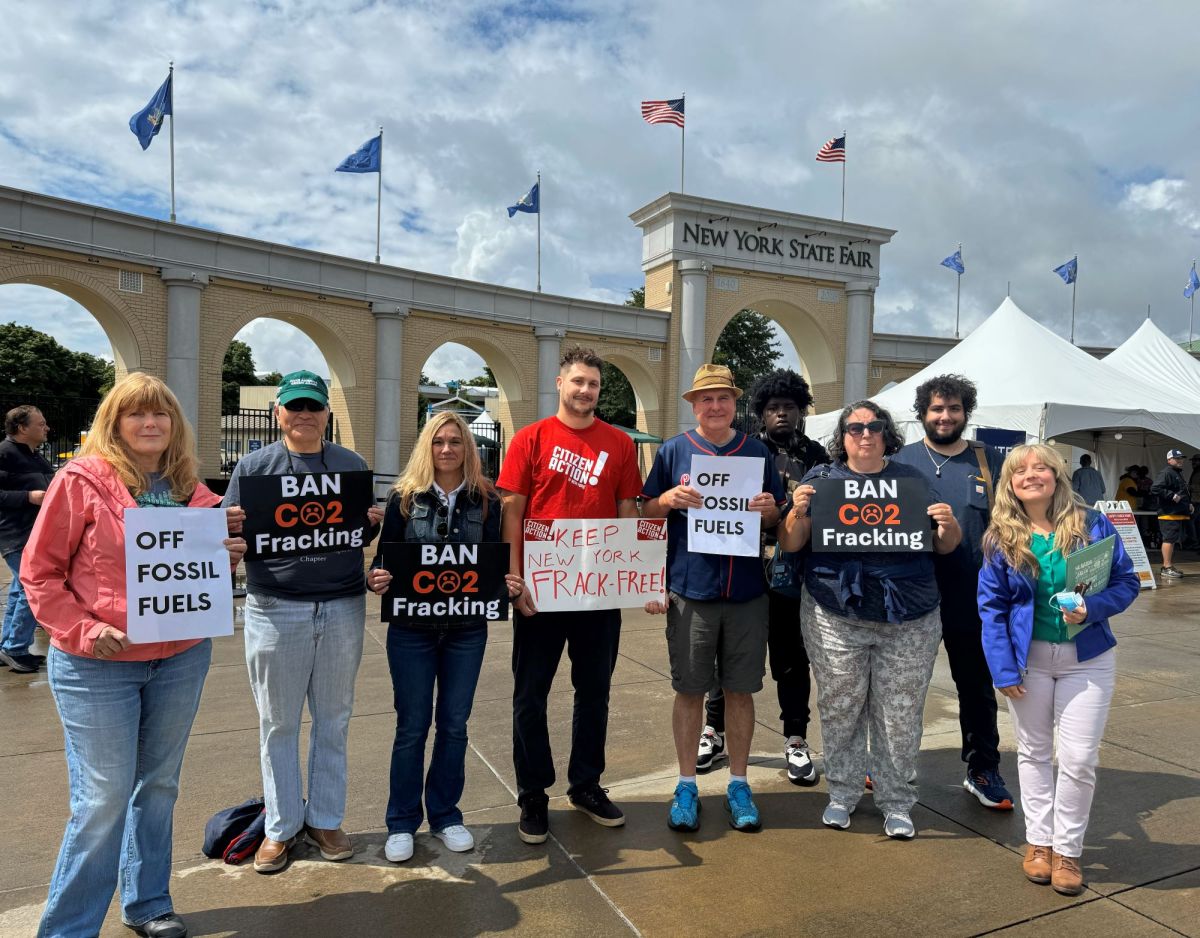
On the first day of the New York State Fair, we call on Governor Kathy Hochul to sign the bill adding carbon dioxide to our state’s fracking ban for the good of our health, environment, and climate.

Join us for Linda’s One-Liner Wednesdays! Find out more here: https://lindaghill.com/2024/08/21/one-liner-wednesday-are-you-allergic-to-anything/

No to CO2 drilling in New York!

One of the things that has been occupying me over these last weeks is the unwelcome and unexpected need to return to the battle against unconventional gas drilling in my home region, New York’s Southern Tier (central NY along the border with Pennsylvania).

I was active with the coalition that successfully advocated for a ban on high-volume hydraulic fracturing in New York, which was first regulatory/executive in Dec. 2014 and made legislative in 2021.

In late summer/fall of 2023, a newly-formed, Texas-based company called Southern Tier CO2 to Clean Energy Solutions, Southern Tier Solutions or STS for short, began approaching landowners in Broome, Tioga, and Chemung counties with lease offers to use supercritical carbon dioxide to extract methane from the Marcellus and Utica shale formations thousands of feet under their land, claiming that it would also sequester the carbon. The scheme would involve thousands of miles of new CO2 and methane pipelines, plus ten or so new methane-burning power plants, which would burn the methane to produce carbon dioxide to use to extract more methane.

Mind you, this has never been done at scale anywhere in the world and does not have any solid scientific backing. The very real negative impacts of high-volume hydrofracking would be compounded by the dangers of carbon dioxide pipelines and injection, all at a time when New York State is implementing its landmark Climate Leadership and Community Protection Act to move us away from fossil fuels and toward renewable energy powering our lives efficiently.

When news of STS’s plans came to light, my New York State legislators, Assemblymember Donna Lupardo and Senator Lea Webb, began asking the Department of Environmental Conservation questions. I admit that I was alternating between fear and disbelief that the hard-won ban might be in jeopardy because it was predicated on the volume of water used and STS’s proposal plans to use supercritical carbon dioxide instead of water.

Fortunately, the coalition that had fought for years to win the hydrofracking ban quickly reconstituted and got to work. A coalition letter from over 90 organizations went out in December. Legislators got to work on legislation to add carbon dioxide to the existing ban with Dr. Anna Kelles as sponsor in the Assembly with Donna Lupardo as a prime co-sponsor and Lea Webb as sponsor in the Senate.

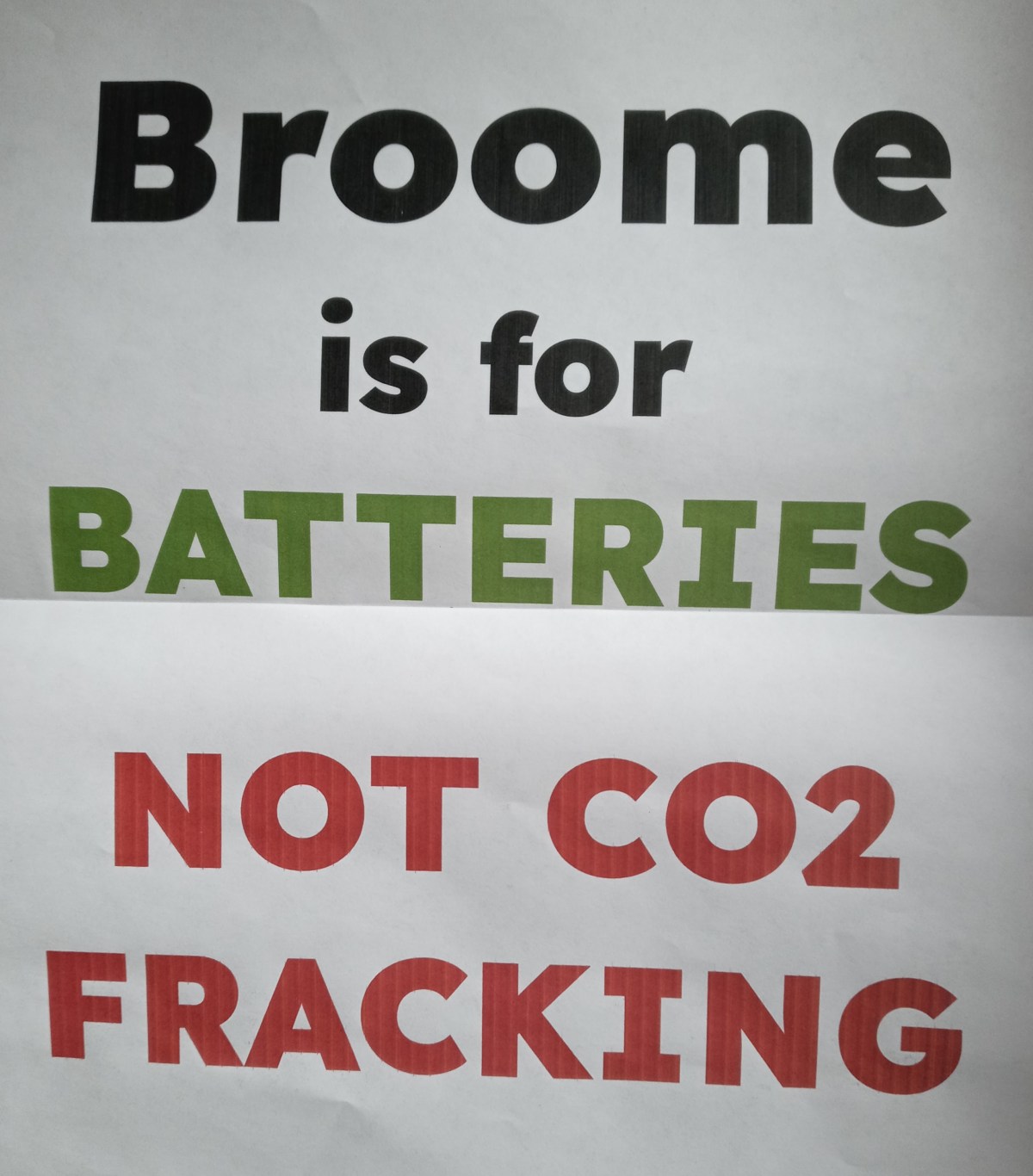
On March 5th, the coalition held a rally/lobby day in Albany. We had great speakers at the rally, including legislators, scientists, and leaders of organizations. I went local with my sign, emphasizing that the Broome County (Binghamton) area is part of the clean energy future as the center of a national technology hub for battery storage through the New Energy New York coalition and neither needs nor wants to be tied to dying fossil fuels. This was my first experience with in-person rallying and lobbying at the New York State Capitol. I was overwhelmed by the noise and busy-ness of it all but grateful to have been able to do my small part in the effort.

I’m thrilled to report that, on March 12th, the Assembly passed the bill with a vote of 97-50 and. on March 20th, the Senate followed with a vote of 45-17. Now, we are moving into the final phase, asking Governor Hochul to sign the bill quickly.

I’m shocked that the coalition was able to get this to move so quickly in Albany. As a Southern Tier resident, I’m immensely grateful to have support from around the state. In the original fight against hydrofracking, there were some very loud voices that were willing to use the Southern Tier as a sacrifice zone to get cheaper methane for their own use; this time, with the CLCPA in place, we didn’t encounter that sentiment as much. I’m also especially grateful to the Third Act Upstate NY working group, who jumped in as soon as I raised the alarm. Third Act is too new an organization to have been around for the original fracking battles but many members have extensive experience with climate activism and organizing and know how to get the word out.

While it seems that this is a local issue of a few counties in New York, the carbon dioxide drilling/sequestration scheme has global implications. Like plastics, it is an attempt by the fossil fuel industry to keep the world dependent on fossil fuels for decades to come, in defiance of the science that demonstrates the need to reduce atmospheric greenhouse gases as quickly as possible to keep the planet livable.

Part of the price to get fossil-fuel bro Joe Manchin’s vote in the US Senate on climate legislation was to include massive subsidies for carbon sequestration. It’s those subsidies that are behind STS’s proposed scheme to profit from the methane in the Marcellus and Utica shales, which is not economically viable to produce on its own. Using carbon dioxide from burning fossil fuels to extract even more fossil fuels is also inherently deleterious to environmental health and the climate. While there may be some instances where industrial carbon emissions can be collected and sequestered, the geology of the Southern Tier would not seem to support long-term sequestration. Sequestration would also be near-impossible in areas with a history of oil and gas wells because there would be too many pathways for injected carbon dioxide to escape.

My hope is that the example of New York banning this extraction/sequestration scheme will help other jurisdictions around the world see through the fossil fuels industry’s increasingly desperate attempts to keep the world burning their dirty products, even with the effects of climate change already causing damage and misery on a global scale.

Watch for news of these kinds of proposals near you. Don’t fall for the lies of the fossil fuel industry. Follow the science. Advocate for clean, renewable energy. Let elected officials know that we need and want protection from pollution and climate change. With so much damage already having been done, we need to act decisively now.

Together, we can move in a positive direction, as we are here in New York.

One-Liner Wednesday: Senate debate

This afternoon in Albany, Senator Lea Webb will lead the effort to add carbon dioxide to New York State’s existing high-volume hydraulic fracturing ban, all of which I will explain in a post at some point…

This (somewhat informative) post is part of Linda’s One-Liner Wednesdays. Join us! Find out more here: https://lindaghill.com/2024/03/20/one-liner-wednesday-technology/

One-Liner Wednesday: Ban CO2 fracking!

Yesterday, 90+ New York State organizations sent a letter to NYS officials, did a press release through Food & Water Watch, and held a press event, requesting that New York ban using carbon dioxide to fracture underground shale formations to extract methane and attempt to sequester carbon dioxide; this is important not only regionally in the Southern Tier of NY where it is being proposed (and where I live) but also nationally and internationally because fossil fuel companies are using this unproven, dangerous, and most likely ineffective scheme for extraction/carbon sequestration to justify their continued drilling for decades to come, despite the gravity and acceleration of climate change impacts.

This long, informative One-Liner is part of Linda’s One-Liner Wednesdays series. Join us! Find out more here:  https://lindaghill.com/2023/12/20/one-liner-wednesday-a-more-honest-version/

Fire in the Amazon

Large swaths of the Amazon rainforest are on fire. Media tends to call these wildfires, but the vast majority of them are intentionally set. I think of wildfires as being caused by lightning strike or an accidental spark. When fires are set intentionally, they should be called arson.

While the current scale of the fires is new, the problem is not. For years, farmers and ranchers have burned parts of the Amazon rainforest to clear land for themselves. They have been opposed by indigenous people and their allies, some of whom have been killed trying to defend the forest.

The fires are devastating for the plants, animals, and people who live there, but the scale of the destruction now threatens the very mechanism that makes the rainforest possible. The vegetation, especially the large, tall trees, transpire large quantities of water, which form clouds and help to keep the rainforest green. If too much land is burned, the amount of rainfall will decrease so much that it would be impossible to sustain a rainforest ecosystem.

Plants also take in carbon dioxide and release oxygen. It is estimated that 20% of the world’s atmospheric oxygen is produced in the Amazon. As more and more of the rainforest is destroyed, the level of oxygen in the air that all people and animals need to breathe could diminish, while the level of carbon dioxide, already at record highs, could become even higher, accelerating global warming and increasing drought, which diminishes plant growth and causes a downward spiral.

The government of Brazil is making only half-hearted measures to control the fires and has refused the assistance of other nations. President Bolsonaro is a climate change denier, who sees this issue as being solely about the economic development of Brazil. His short-sighted actions may cause world-wide suffering for decades.

It highlights to me how interconnected we are as a planet. At this point in human history, we can’t afford countries being isolationist and concerned only with making their rich citizens even richer.

Money can’t buy oxygen or make more rainfall or change the temperature.

common sense climate science

Although we hear news about atmospheric carbon dioxide levels often, there are several other greenhouse gases which are also affecting the global climate.

One of the most potent greenhouse gases is methane which is 86 times more potent than carbon dioxide when measured over a twenty year period. Atmospheric methane is also at record levels. After a relatively stable period, it began rising in 2007.

While no definitive science report has yet been published as to the cause of the rise, I have a common sense guess. The rise of atmospheric methane began to rise with the advent of high volume hydraulic fracturing for oil and gas in the United States. Other sources of methane, such as agriculture and waste disposal, have not seen any large expansion in this timeframe.

There have been a number of measurements that have traced atmospheric methane and other VOCs to fossil fuel sources, including well pads, compressor stations, processing equipment, and pipelines. A number of studies have been published using these data. These data show that actual methane emissions are much higher than those that the industry and the EPA had estimated.

This gives even more urgency to rapidly transitioning away from fossil fuels to renewable energy. It is critical to restrict methane emissions to avoid climate tipping points, such as large scale permafrost melting and the release of methane hydrates from the cold water seas.

I am proud that our grassroots organizing managed to hold off fracking here in New York State. There is still a long way to go, but we are making progress. We won’t stop until fracking and other unconventional fossil fuels are a thing of the past.

SoCS: two degrees

Two degrees Celsius is the threshold between what is considered impactful but manageable global warming and catastrophic global warming. Climate scientists will tell you it isn’t that clearcut. We are already seeing major impacts at only one degree-ish. At two degrees, we may get major feedback loops happening, like the melting of permafrost and the release of methane hydrates from northern seas and oceans which would accelerate warming further.

Two degrees C. has been translated into 350 ppm carbon dioxide. We have now topped 400 at times in the atmospheric readings on the Big Island of Hawai’i – I think it is Mauna Kea, but it could be Mauna Loa – and the levels keep rising.

What is disturbing me even more is that global atmospheric methane, after a long period of stability, began rising in 2007. Methane is more short-lived in the atmosphere than carbon dioxide, but is a much more powerful greenhouse gas – 86 times more powerful in a twenty year context and 106 times more powerful in a decade. Given that our timeframe to get global warming under control is now very short, methane in the atmosphere is particularly troubling as it has such a strong effect in the immediate future.

So, why do I hear the word degrees and immediately go into my global warming spiel?  I write about this a lot, as an offshoot of my commentary on the dangers of shale oil/gas aka unconventional fossil fuels aka fracking.  I have spent countless hours writing and researching and commenting on these topics.  It started as a personal thing as my state, New York, is currently under a moratorium, while our neighbor state Pennsylvania is drilling extensively. And I live in a border town.

I could literally write about this for hours, but I will spare you. I apologize if I was unclear at all in this post. It’s the whole stream of consciousness thing – no fact-checking or editing allowed…

This is part of Linda’s Stream of Consciousness Saturdays.  This week’s prompt was “degree/degrees.”  Join us! Read how here:  http://lindaghill.com/2014/10/24/the-friday-reminder-and-prompt-for-socs-october-2514/


Badge by Doobster @Mindful Digressions