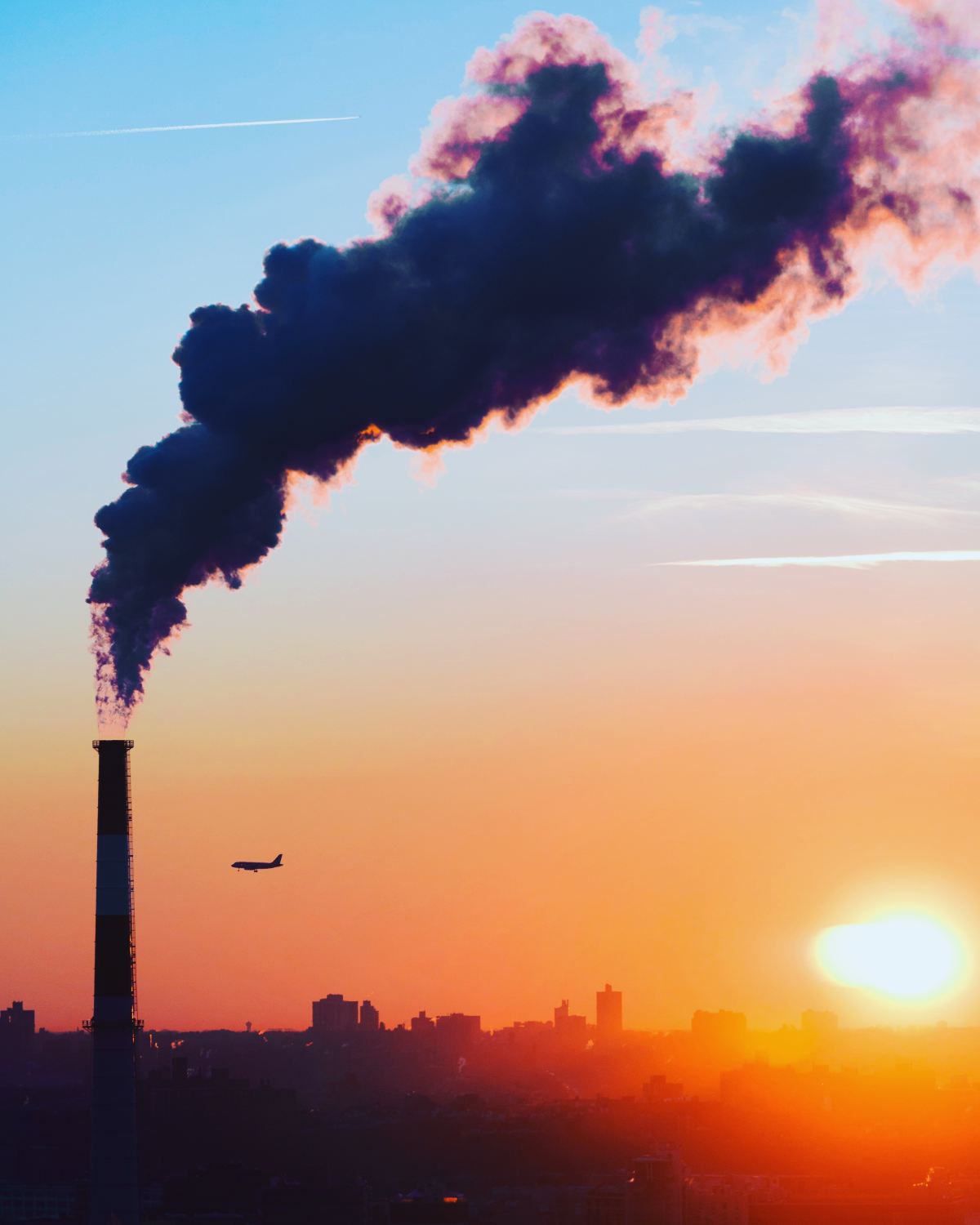
So, bottom line: when you burn fossil fuel you produce particulates which lodge in lungs and kill you (one death in five on the planet comes from breathing the byproducts of fossil fuel combustion), and when you burn fossil fuel you produce carbon, which lodges in the atmosphere, driving heatwaves and floods that kill you.
B took this photo in front of our house yesterday morning (June 7, 2023) as the early morning sun tried to break through the wildfire smoke coming down from Quebec, several hundred miles away.
Things got worse as the day went on.
The air at ground level smelled like a campfire and an orange-tinged haze reduced visibility so that you couldn’t see the hills or tell where the horizon was. You could see smoke in the air just looking across the street. You needed indoor lighting even with the drapes pulled back on the windows.
We were keeping a watch on the air quality index numbers from airnow.gov. By mid-afternoon, they reached 460, well into the hazardous category. At that level, people should stay indoors with filtered air. If people have to be outdoors briefly, they should wear masks that are good at filtering out particulates, such as N95 or Kf94. Fortunately, many people still have some on hand from our pandemic experience.
B came home from work early because the smoky air began penetrating the stairwells in his building. It became quite windy. I was hoping that there were some rain clouds up above the smoke but no precipitation fell.
We aren’t alone in this phenomenon. Much of the Northeast and Mid-Atlantic regions of the US are having significant smoke impacts, sometimes even worse than areas in Canada that are much closer to the fires, due to a stationary low pressure system that is circulating in such a way that it draws smoke in our direction. It’s been a dry spring, so there are hundreds of wildfires in Canada right now, with over two hundreds that are considered out of control.
That’s a lot of smoke.
We need rain to help quell the flames and to prevent even more fires from erupting. Also, the plants and animals need more water. We are getting to what should be peak strawberry season here but the crop is expected to be low due to lack of rain, although a late freeze in May didn’t help matters.
As frequent readers may recall, I’ve been active around environmental issues for a number of years, particularly around climate change. I know that the extra carbon people have put into the air through fossil fuel extraction and use, deforestation, unwise agricultural practices, etc. has increased the risk of all kinds of extreme weather events. It makes the likelihood of heat waves, droughts, and wildfires higher and the changes in the air, land, and ocean temperatures make severe storms and stalled weather systems more likely.
We can see it with our own eyes.
I’m frustrated that corporations, politicians, and world governments did not make this a priority years ago. We might have averted some of the impacts we are experiencing now and reduced our future risk. I’m grateful that some action is coming on line now, but we need to make changes more quickly and more universally to reduce the severity of hurricanes/typhoons, wildfires, droughts, floods, sea level rise, biodiversity loss, heat waves, coral bleaching, etc.
In my little corner of the word along the New York/Pennsylvania border, we have a bit of improvement today. For the last few hours, our air quality is rated as “unhealthy for sensitive groups” rather than hazardous for everyone, although I know that, in the New York City area, airports have had to suspend service due to lack of visibility from the smoke. Washington, DC is having a purple alert for air quality, which is one level higher than red alert. The upper level winds have shifted enough that we aren’t in the worst sector today, but others are suffering higher levels than yesterday.
My fear is that a report that I heard today will come true – that this pattern will repeat itself throughout the summer.
It’s hard to predict.
A moment ago, I saw a bit of sunlight break through. I looked out the window and can see the sky with some clouds.
I haven’t seen the sky for a couple of days because of the smoke.
The clouds don’t look like rain is imminent, but I will try to have hope.
I spent a lot of time involved with the eventually successful efforts to ban high-volume hydraulic fracturing (fracking) for fossil fuels in New York State. Meanwhile, from my town on the NY/PA border, we have watched a host of negative consequences unfold for some of our PA neighbors. I am also only an hour or so from Cornell University, home to some of the leading researchers on fracking. I was privileged to see these professors speak a number of times, both on campus and at community events.
One of these researchers, Dr. Robert Howarth, has just published a new paper in the journal Biogeosciences about one of the most unfortunate environmental effects of the fracking boom, the release of methane to the atmosphere. Global atmospheric levels of methane are at all-time highs since recording began. The levels started a steep rise in 2006, just as the fracking boom in the United States was picking up.
Having heard and seen so much evidence of methane leakage from fracking, I had already assumed that the two were related, but, in this paper, Dr. Howarth explains the evidence by measuring the amount of 13C present, allowing him to determine the part of the global rise in methane related to fracking, most of which was emitted in the United States. The industry tries to tell us that they are controlling methane emissions through detecting and fixing leaks on the wellpads, but there are many other ways in which methane is released, including venting and flaring at the site, especially in areas where the methane is released when the company is primarily drilling for oil; well leakage that develops over time as casings fail; methane that seeps through the ground to the surface, similar to the way radon reaches basements when it originated thousands of feet below; abandoned wells when fractures intersect with them; compressor station leaks and releases; leakage from transmission and delivery pipes, some of which are over 100 years old; and the production, transport, and use of LNG.
Methane is a much more powerful greenhouse gas than carbon dioxide but is relatively short-lived in the atmosphere. This makes reducing it quickly imperative in the effort to limit global temperature rise to 1.5 degrees Celsius.
It is also why the more ambitious climate plans in the United States, such as those of Gov. Jay Inslee and Sen. Bernie Sanders, call for a ban on fracking.
The sooner this happens, the better. The economics of fracking are already poor, with a number of companies going bankrupt because of it. In many markets, renewable energy is cheaper than fossil fuel energy already and energy storage technology is progressing rapidly while falling in price. It’s time to ban fracking and new fossil fuel infrastructure and go all in for renewable energy, energy storage, and energy efficiency.
We need to do all we can to keep the planet livable for people and all other life forms. Banning fracking would be a great step in the right direction.
I am a veteran of the fight against shale gas development in New York State, and, more broadly, against unconventional fossil fuel development and for a rapid increase in renewable energy in order to cut greenhouse gas emissions and keep global warming as low as possible.
I am fortunate to live in the Binghamton area, not that far from Ithaca, where several prominent scientists and professors work. They often came to speak at events in Binghamton and I sometimes would travel to Ithaca for lectures. I learned a lot from them and would use their research in commenting on news articles and in writing blog posts.
One of my favorite speakers is Dr. Anthony Ingraffea, Dwight C. Baum Professor of Engineering Emeritus at Cornell University. His specialty is rock fracture mechanics and he had done hydraulic fracturing research for many years, putting him in a unique position to anticipate the dangers of combining high-volume slick-water hydrofracking with long laterals in shale. He teamed with Dr. Robert Howarth, an environmental scientist at Cornell, in the first major paper raising an alarm about methane leakage from shale oil/gas development; the paper was controversial, but prescient, with subsequent research affirming levels of methane leakage much higher than industry and government projections.
This newly released twelve minute video with Dr. Ingraffea shows the climate consequences of the decision to develop shale gas. This blog post by Sharon Kelly gives some further background and also has a link to the video, in case the embedded one below isn’t working.
Although we hear news about atmospheric carbon dioxide levels often, there are several other greenhouse gases which are also affecting the global climate.
One of the most potent greenhouse gases is methane which is 86 times more potent than carbon dioxide when measured over a twenty year period. Atmospheric methane is also at record levels. After a relatively stable period, it began rising in 2007.
While no definitive science report has yet been published as to the cause of the rise, I have a common sense guess. The rise of atmospheric methane began to rise with the advent of high volume hydraulic fracturing for oil and gas in the United States. Other sources of methane, such as agriculture and waste disposal, have not seen any large expansion in this timeframe.
There have been a number of measurements that have traced atmospheric methane and other VOCs to fossil fuel sources, including well pads, compressor stations, processing equipment, and pipelines. A number of studies have been published using these data. These data show that actual methane emissions are much higher than those that the industry and the EPA had estimated.
This gives even more urgency to rapidly transitioning away from fossil fuels to renewable energy. It is critical to restrict methane emissions to avoid climate tipping points, such as large scale permafrost melting and the release of methane hydrates from the cold water seas.
I am proud that our grassroots organizing managed to hold off fracking here in New York State. There is still a long way to go, but we are making progress. We won’t stop until fracking and other unconventional fossil fuels are a thing of the past.


 Joanne Corey