As I was posting about yesterday, things are pretty distressing in the United States these days.
I am, though, finding support and reasons to hope.
Although I wish it hadn’t taken such a dire convergence of events to do, I find hope in the millions of people around the world who are drawing the fights against injustice, inequity, climate change, oppression, inequality, poverty, violence, and lack of education, opportunity, health care, affordable housing, etc. into a new vision for the common good, for care of each person and community, and for the planet. The massive disruption that we are experiencing from the pandemic and the resulting social and economic impacts gives us the opportunity to re-build in a positive, sustainable way. The House Select Committee on the Climate Crisis has just released a major “Congressional Action Plan for a Clean Energy Economy and a Healthy, Resilient, and Just America.” This is the kind of thinking envisioned by many long-time social justice advocates and by Pope Francis’s encyclical Laudato Si’. While there will be obstacles to enacting such large-scale change, there finally seems to be momentum toward adopting and implementing meaningful reforms, which gives me hope.
There are personal signs of hope, as well.
Sometime this summer, a new grandchild will arrive, a sibling for ABC. While we have no idea when it will be either allowed or advisable to travel to London, both ABC and the new little one are signs of hope for the future, as well as powerful motivation to makes things better for them.
Earlier this week, a lovely surprise appeared in my mailbox, a card with a beautiful photograph of a mother wood duck swimming with two ducklings. It was from two Smith college friends who are twin sisters, vacationing together on a lake in New Hampshire. They were thinking about me awaiting our new far-away grandchild “across the pond” and sharing their own family stories, filling my heart with love and joy.
They both mentioned my writing, which I appreciated. I’ve also recently received a couple of emails from a poet-friend in reaction to my posts here at Top of JC’s Mind. I enjoy reading and responding to comments here, on the TJCM Facebook page, and on my personal page, too. Sometimes, it seems as though I write and publish posts – and have no idea if they are actually reaching anyone. I don’t often look at my blog stats, but, even when I do, a visit doesn’t necessarily equal a read. My visit stats also don’t reflect people who receive posts via email. I sometimes find myself surprised that friends know certain stories or viewpoints from me when I know we haven’t discussed it, forgetting that I had posted about it. (Conversely, I sometimes think that everyone knows a certain thing because I’ve written about it, forgetting that many friends and family members don’t read my blog.)
Perhaps, hope is not the proper word, but I do so appreciate the sense of connection that comes through sharing our words and thoughts and emotions with each other. When I do have the privilege of interaction, it reminds me that I am not just scrawling words into cyberspace without purpose.
There is always the hope that someone is reading, mulling, and reacting.
For decades, public opinion polls in the United States have asked how satisfied people are with the way things are going in the country, which is often referred to often as the country being on the right or wrong track. A Pew Research Center poll released on June 30th reveals that only 12% of respondents are satisfied with the direction of the country.
Twelve percent is a shockingly low number, but the number today could be even lower, given that the poll was conducted before the revelations about Russia paying bounties for the deaths of United States and coalition troops in Afghanistan, before the daily national number of new positive COVID tests reached 50,000+, and before 38 of 50 states reported rising numbers of cases on a 14-day rolling average.
The COVID numbers are going to get worse in the coming days because the seven-day rolling averages are already worse and because there are likely large numbers of people who are positive but not yet showing symptoms or being tested.
The rise in COVID cases is all the more upsetting because much of this precipitous spread was avoidable. I have written often, for example here, about the battle against the pandemic in New York State, where I live in its Southern Tier region. By following the science and metrics, our state went from having the worst infection rate in the country to the lowest. Mask-wearing, physical distancing, travel restrictions, and enhanced sanitation are part of daily life for nearly all people here. New York, which suffered the first wave of COVID cases coming in undetected from Europe, pioneered many ways to crush the coronavirus curve and keep infection rates low through robust testing, contact tracking and quarantine. It breaks my heart that other states and the country as a whole are not following a similar path to protect their residents and visitors. Governor Cuomo’s office has been in contact with governors’ offices around the country, offering assistance in fighting the virus, but it seems that few are willing to put the lessons we learned into practice in their states.
While we continue to methodically re-open different types of businesses and increase the size of (reasonable and still distanced) gatherings allowed, we keep constant watch on our testing numbers, ready to change plans immediately if the number of positive tests starts to rise. Our greatest threats at this point are complacency among people here leading them to get sloppy with our preventive measures and the risk of travellers bringing the virus with them from another state or country. New York does have quarantine rules in place for those entering the state from places with high infection rates, but we would be much better off with a national policy based on science and metrics.
I think the national polling numbers with which I began this post show that our ship of state is seriously off course and in danger of shipwreck. The vast majority of the country knows it, as does most of the rest of the world. Travel from the United States into the European Union is banned. Both our allies and our adversaries wonder how a strong and proud democracy could have a national government in such impotent disarray.
Long-time readers know that I occasionally indulge in political fantasy. I had one for a while that both DT and the VP were forced to resign due to corruption and that Speaker of the House Nancy Pelosi would become the first woman president of the United States. During the impeachment of the president, some argued that we should wait for an election to get DT out of office. I don’t think any of them imagined the dire mix of pandemic, attack by foreign adversaries, economic collapse, and cries for long-overdue justice and equity with which we are currently dealing. To avert more disaster and to safeguard lives and well-being, we need new leadership now, not on January 20, 2021.
I call on the president, the vice-president, and all appointed Cabinet and high-ranking officials of agencies who are not career professionals within their departments to resign, so that Pelosi, aided by experienced civil servants, can put in place national policies to stem the pandemic and to run a fair election in November, so that the newly elected president has a chance to inherit a country that isn’t a complete disaster area. Some problems could be addressed by executive order and, one hopes, others could be handled legislatively, if enough Republican senators step up to govern, instead of letting Majority Leader Mitch McConnell kill nearly every House-passed piece of legislation that lands on his desk.
2020 has been a year in which we hear the word unprecedented on a regular basis. My suggested course of action certainly would be unprecedented, but I think it offers hope of alleviating at least some of the suffering around us and averting more. It is also constitutionally valid.
Unprecedented times call for unprecedented measures.
Earlier this month, I wrote about June birthdays and mentioned B and my 38th wedding anniversary while writing for Stream of Consciousness Saturday here.
Our celebration of our anniversary was different this year. We usually try to go away for a couple of days, usually to a small inn in an historic, picturesque location where there are nice places to stroll and good restaurants.
This year, B did get to take most of the day off from his now-working-from-home job. We did go out briefly for a couple of socially distanced errands and an afternoon visit to the walk-up window at a favorite local ice cream shop, but we made dinner at home with T and had a quiet evening in. All of which seemed right for this somber time.
Thirty-eight years is a respectable amount of time for a marriage and gives me hope that, if we can keep life-threatening disease at bay, we will be able to celebrate our fiftieth anniversary, as we were able to do with our own parents.
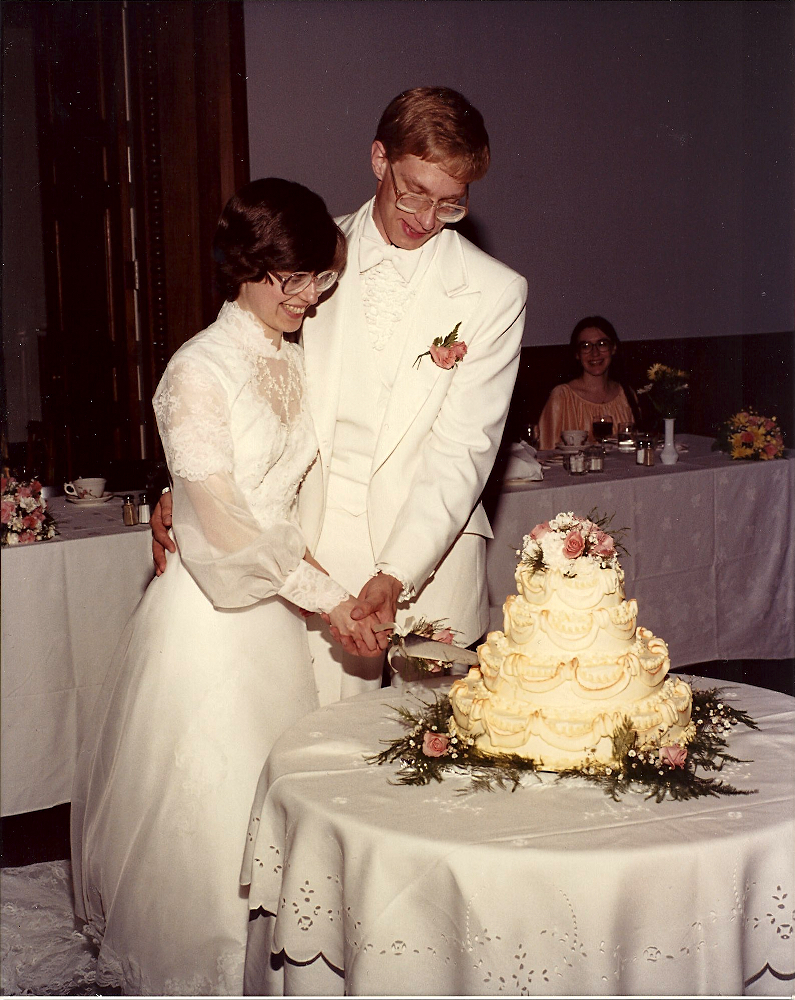
Perhaps because we are hearing so much about people changing the date or plans for their weddings, I find myself thinking about B and my wedding, the changes in plan that it entailed, and how it was perceived.
Because B and I were planning to marry shortly after I graduated from Smith College, my mother and I did most of the planning the summer before my senior year. Those were still the days where the tradition of the bride and her family doing most of the wedding arrangements (and paying the costs) was still observed, especially when the bride was young and not established in a career. I chose to be married at Helen Hills Hills chapel on the Smith campus. I had been involved in the life of the chapel throughout my years at Smth, as an organist, choir member, and accompanist and was close to Sister Judith, the Catholic chaplain. The reception would be at the Alumnae House, a short walk down Elm Street from the chapel.
There was no resident priest on campus, so an associate from one of the Northampton parishes presided at mass on Saturdays. I asked him to preside at our wedding ceremony and he agreed. In January, he was re-assigned to a nearby city and decided that he would not come to the wedding. A young priest who was assigned to the University of Massachusetts-Amherst was filling in at Smith for the spring semester became the default priest for our wedding.
This turned out to be very problematic.
He didn’t know me – that I had been serving as a Catholic church musician for over seven years, that I took my faith seriously, and that I had also studied the history of Christianity in the United States and around the world. He also didn’t trust me, which was hurtful. When I met with him to do the questionnaire that is required, he made me swear on a bible to tell him the truth, as though I was going to lie to a priest.
In May, during the reading period before my last-ever final exams, the priest and I were taking a walk on the Smith campus to finalize some of the details. Because B is not Catholic, we were having a ceremony, not a mass, which should have made things more flexible. The priest, however, would not allow any changes in wording, would not allow Sister Judith to read the gospel or offer a reflection, which should have been allowed outside a mass. As we were finishing the walk, he said to me that he thought I would be more comfortable being married in a non-Catholic ceremony.
I was devastated. It was six weeks before the wedding and I didn’t have a member of clergy to preside. I went to the chapel offices in tears. Sister Judith wasn’t there, but Rev. John, the ecumenical Protestant chaplain was. He immediately offered to preside and gave me some different prayer books to look through to find a new ceremony to follow. We had to file dispensations of place and form so that the Catholic church would recognize the marriage and the priest would still read the vows, although they would be from the Episcopal Book of Common Prayer. The best outcome was that Sister Judith delivered a beautiful reflection.
People often say that their wedding days are perfect and they wouldn’t change a thing, but there are some things I would change if I could. I would have made a recording of the ceremony because Sister Judith spoke without notes, so I have only memories and not a record of what she said. I also would have ignored the advice of the wedding gown shop and not worn heels and a headpiece that stood up on my head. Because B is about ten inches (25cm) taller than I, they were trying to make me look taller, which seemed silly at the time and even sillier now. Most of all, I would change the trauma and drama of the clericalism that led to my not having a Catholic wedding, the clericalism that still infects the church and causes so much damage.
Our wedding and reception were designed to be an adult affair, so we didn’t invite children. This wasn’t unusual at the time, but didn’t set well with a family member who wanted their grandchildren to be invited. I’m still sorry that those young cousins had a very boring day.
Some of the adults were bored and upset, too, although I, thankfully, was not aware of it at the time. The Alumnae House could serve wine but not liquor, which upset some people who somehow thought they were owed an open bar. We also did not have dancing; neither B nor I enjoy dancing and Alumnae House is not set up for it. After dinner and our delicious spice cake with buttercream icing, a break from the super-sweet white cake with white frosting that was traditional at the time, B and I went from table to table, visiting with our guests. Strangely, after we talked to people at a table, most left, so that, by the time, I changed to leave for our honeymoon, only immediate family and a few close friends were left to wave good-bye.
I don’t regret our reception choices, which reflected our personal style and preferences. I was sad that some guests gave my mother grief, although I didn’t realize that was happening at the time; it was very rude. I was also sad that people were putting their expectations over our true-to-ourselves choices.
My biggest take-away in looking back on the not-entirely-perfect wedding day that B and I had 38 years ago and in hearing so many stories of couples re-defining their own weddings due to the pandemic is that, while weddings are important days in our lives, they are just one day in a marriage. The accumulation of those days, each presenting joys and challenges, is what is most important.
While I wish I was saying that the Boiler House Poets Collective is together in person and giving a reading somewhere, this announcement is that we now have a public website.
There are three pages on the site: a standard “About Us” for a bit of history and general information; a page with projects we have done together, including videos which are embedded; and a page with links to books, blogs, websites, and videopoems that individual members of the Boiler House Poets Collective have been involved with as writers, editors, or creators.
I have frequently posted here about being in residence at the Massachusetts Museum of Contemporary Arts with the Boiler House Poets Collective. If you search for MASS MoCA or Boiler House, you’ll get lots of posts about the residency and the poets who have taken part – and a fair amount of soul-searching, discovery, and wonder on my part. Because I am from the North Adams area and graduated from the high school there, there is another level of experience and memory that I bring to the residency. It heightens my sense of being there as a learner, surrounded as I am with more experienced poets and with art. My formal education in visual arts and poetry is sparse and I am forever grateful to my poet-friends for their patience and generosity in helping me grow as a poet.
Sorry for the digression. Back to the website and the Boiler House Poets Collective!
We began in 2015 as part of a collaboration between Tupelo Press and the newly formed Studios at MASS MoCA, which brought together a group of nine poets, most of whom had never met, for a week of poetry and art. The poets bonded so well that we have returned for a reunion residency every year. Because of the housing and studio set-up, we return as a group of eight. Because not all the original poets have been able to return, we have, over the years, brought in poet-friends to fill spaces, so we have become a larger collective and hope to continue as a group far into the future.
This pandemic year is complicated for us. We had reserved our usual week in early fall for our reunion, but we have no idea if MASS MoCA and The Studios will be open and if Massachusetts will be allowing out-of-state visitors without a long quarantine required. Still, I know that we poets will stay in touch and support each other remotely until we can be together physically again.
If you have any comments about the site, you may leave them here or email them to boilerhousepc@gmail.com. Either way, I will respond as best I can. Even though I am, by no means, qualified enough to deserve the title “webmaster,” I did set up the site and am responsible for maintenance. If you want to compliment any of the individual poets or find out more about their work, I will make sure that your message is forwarded to them.
On behalf of the Boiler House Poets Collective, thank you!
We are almost at the end of strawberry season here in upstate New York.
When I was growing up in rural New England, we always went strawberrying every spring and made lots of recipes with the fresh, flavorful berries. Back then, you only had access to fresh strawberries when they were available locally. Now you can buy them in the grocery store year-round grown somewhere far away, but we seldom buy them because they are never as good as local ones.
For many years, I picked my own from nearby farms, but now I buy them from the farmstands and embark on the annual strawberry binge.
This year, we had some of our old favorites – strawberry shortcake, fresh strawberry pie, strawberry-rhubarb pie, strawberry salad, strawberry sundaes, strawberries with yogurt, and strawberries on pancakes. We also tried some new recipes – strawberry spoon cake, strawberry-rhubarb muffins, fresh strawberry tarts, and strawberry bread pudding.
Wow! That looks like a lot when it is all written out.
I think it will tide us over until next spring, when I’m sure we’ll be ready to dive into strawberry season once again.
Our family physicians’ practice has a research department that works in conjunction with national trials. I have done several studies with them in the past, including vaccines for seasonal flu and adult RSV (respiratory syncytial virus).
I got a call the other day because they are signing people up for a SARS-CoV-2 vaccine trial. This is the virus that causes COVID-19. It will be a two-year study looking at the effectiveness of the study vaccine. I qualified and enrolled in the study, as did spouse B and daughter T.
We don’t know whether this vaccine will prove to be effective or for how long, but we are committed to being part of the process to find out. Even if it isn’t protective, that information will be helpful in the search for finding a vaccine that is.
They are looking for more participants. If you are in the Binghamton NY area and are interested, please contact me for a referral to the researchers who can provide full information about the study. You may leave a message in the comments so we can work out how to communicate privately or contact me through Facebook Messenger or email if we are already connected.
In the first few seasons of The Late Show, Stephen Colbert did a recurring skit, now a best-selling book, called Midnight Confessions, in which he “confesses” to his audience with the disclaimer that he isn’t sure these things are really sins but that he does “feel bad about them.” While Stephen and his writers are famously funny, I am not, so my JC’s Confessions will be somewhat more serious reflections, but they will be things that I feel bad about. Stephen’s audience always forgives him at the end of the segment; I’m not expecting that – and these aren’t really sins – but comments are always welcome.
JC
After all the safer-at-home pandemic protocols, I’m afraid that it will be difficult for me to resume going back out to church, meetings, events, etc.
The truth is that I am both introverted and shy. It takes a lot of energy for me to be in a group setting and even more for me to actively participate. I much prefer one-on-one interaction, the exception being among family.
I wrote yesterday about the explosion of Zoom and other virtual meetings. I’m finding that these are also very draining and even more difficult to navigate than in-person meetings, because it is harder to gauge how/when to break into the conversation when we are each in our own little box.
I wonder if some of the group activities I used to do will even exist after a vaccine makes social interaction relatively safe again. While I had been mourning my lack of a chorus with whom to sing, now no one has a chorus available and may not for a long time, given that singing in a group is an especially dangerous virus-spreader. The spirituality group that I have facilitated for years at church is almost entirely people in high-risk groups and we don’t have the option to go virtual due to technical limitations.
Some organizations, like the Binghamton Poetry Project, will eventually have to decide if they go back to in-person meetings or stay in Zoom, which allows people who don’t have transportation or who live outside the area to participate.
It’s possible that there won’t be many groups expecting my physical presence when we get to the post-pandemic world, but there will no doubt be some. Will I be able to muster the energy to venture back out on a regular basis or will I just stay home?
Over the past several years of spending a lot of time as a caregiver, I’ve valiantly tried to cut down the size of my email inbox, which is often overflowing with news, newsletters, and calls to action from various charitable, social justice, and environmental causes, along with personal and poetry-related emails. Even with my diligent attempts, I routinely handle over a hundred emails a day, which is still a lot, so I am unsubscribing from even more email lists and trying to avoid signing too many petitions which lead to my being on even more lists.
Paradoxically, as we have been avoiding in-person meetings over these last months, my inbox is full of invitations to connect via Zoom or Go to Webinar or some other platform. Instead of having fewer demands on my time, there seem to be more.
I can’t keep up.
In order to create some semblance of order, I’ve decided to narrow the selection of online events that I will accept. Of course, I will continue with my local poetry circle, which I call the Grapevine Group after the cafe where we used to meet pre-pandemic. I am also looking forward to the five-week summer session of the Binghamton Poetry Project, which, for the first time, is breaking into a beginner and a more experienced section. I am also signed up for six summer sessions with a local spirituality center that has had to re-convene virtually rather than offering in-person programs and retreats.
Beyond that, I plan to accept a very limited number of educational/advocacy meetings on social/environmental justice to keep informed and to take directed action. I am heartened by the increasing convergence of climate/environmental justice with racial/economic justice and want to advocate for effective change.
Beyond that, I hope to say “No” and continue to unsubscribe so that I have more time to accomplish what I need to and respond to ever-shifting circumstances.
(She writes, hoping she can actually manage to do so.)





 Joanne Corey