One-Liner Wednesday: Voting

“Voting is a civic sacrament.”
– Father Ted Hesburgh

(Apologies for being US-centric in the timing of this, but, given that the vast majority of people reading this live in democracies, voting will be pertinent at some point in the year.)

Join us for Linda’s One-Liner Wednesdays! http://lindaghill.com/2014/10/29/one-liner-wednesday-eh/

Dear Governor Cuomo

IMG_0083

I sent this letter to New York Governor Cuomo today on the election and shale drilling and equal protection and climate change and science and more.  I know it is overly long – although I could have written much, much more – but I am proud that I managed to get this done before the election, despite the disruption that recent family health issues have caused. I decided to write this today, even though I have 385 email messages to view, so apologies to anyone awaiting a personal email.
JC

Dear Governor Cuomo,

The election is eight days from today, but I do not think I will be able to vote for you because you are not doing enough to protect the health and safety of all New Yorkers equally.

I live in Vestal and I and my Southern Tier neighbors are at risk from the health and environmental impacts of shale gas production, processing, transport, and waste disposal, a risk from which you have not protected us.

Some of the impacts that have already occurred are road damage in Vestal from the overweight trucks transporting drilling supplies to sites in Pennsylvania, inability to get mortgages on leased land, crime associated with gas industry workers staying on the NY side of the border, leaking pipelines, increased truck traffic, light and noise pollution, airborne silica sand along rail lines and during trucking transfers, and an explosion at a Windsor compressor station.

Other impacts are probable but not being tested, such as degradation in air quality.  Some impacts are obscured by the lack of tracking of the fossil fuel industry.  For example, waste products are shipped by truck without the exact composition being known, so that if they are disposed of at a landfill the effects on the leachate are unknowable.  Given that some of this leachate is treated in Endicott, this is a local concern as well as a regional one.  Meanwhile, it is still legal to spread drilling wastewater on roadways in New York, despite the fact that we know that Marcellus wastewater is often high in radium, which is a radioactive, toxic element known to bio-accumulate and cause serious health problems, including cancer.

Other impacts are, of course, global in scope.  The latest readings of atmospheric carbon dioxide are at record highs and we know that humans burning fossil fuels have been the driving force in that.  Also, the atmospheric methane level is at a record high.  Methane is a much more potent greenhouse gas than carbon dioxide, 86 times more potent in a twenty year timeframe. After a long period of stability, atmospheric methane levels began rising in 2007, coinciding with “shale boom.”  Several new scientific studies say that replacing coal or diesel fuel with fossil methane will not help our climate situation.  Shale development will not cut the risk of the next record flood here in Vestal or the next superstorm roaring up the Atlantic coast.

I have been trying to follow the DEC’s SGEIS and regulatory process for years now.  I say “trying” because the process itself is obscure.  Besides the obvious problem of the Minerals division trying to promote fossil fuel production while also trying to regulate it, there is the larger problem that the DEC’s work has been hidden from the public for years now. Because there has been a large number of independent, peer-reviewed scientific research studies published in the last two years, the last publicly available draft of the SGEIS is totally outdated, but we have no idea whether or not the DEC has been continuing to update the SGEIS as these new scientific studies and data from other states who are drilling have become available.

The obscurity of the process has been compounded by the DOH “review” of the the health findings of the DEC’s work.  Although this has been referred to as a study, it is not.  A real health study would follow the national/international guidelines of a health impact assessment (HIA) and would be conducted as a clearly defined, public process. It would consider health impacts on different groups of people, such as children, the elderly, and pregnant women/infants. It would look at the interplay of exposures to many different substances and the interactions among them. It would look at impacts for those in close proximity to wells and related infrastructure and those further away, including air quality, possible food and water exposures, and climate impacts.  It would also consider socioeconomic changes, such as rates of crime and homelessness, property value, cost of living, stresses on community services, and gains and losses in different job categories.

The economic section of the draft SGEIS is particularly outdated and unrealistic, having been built on what we now know are totally impossible expectations, that the industry could get economically viable amounts of gas anywhere in the Marcellus and Utica.  The price of methane is so low that it is unlikely anywhere in New York can presently produce shale gas economically, with the danger that small companies would take that risk using borrowed money and leave behind wells that cause pollution that the state would need to clean up when the company goes bankrupt.  New York already has thousands of leaking, abandoned wells awaiting proper plugging; we should not compound the problem with even limited amounts of shale drilling.

Governor, you say over and over that the science must decide, but that you are not a scientist. You say that scientists disagree.  The actuality is that industry-funded science is presented and used in a way that makes it seem that shale drilling is safe, while independent science presents data and possible explanations for that data which show that there are environmental and health impacts occuring. A recent example of this is the media coverage of a recent federal Department of Energy study of a single PA deep shale well for eighteen months, which showed that fracking chemicals had not reached an aquifer 3,000 feet distant, which is being touted as “proof” that “fracking” doesn’t pollute water.  Meanwhile, a PNAS study of the official DEP records of PA wells drilled from 2000-12 which covers tens of thousands of wells and their failure rates (Abstract here: http://psehealthyenergy.org/site/view/1217 with link to full report) shows that leakage rates for new shale wells in Northeastern PA are significantly higher than those for conventional wells and for shale wells drilled in the rest of the state. Leaking wells equals methane migration into groundwater, soils, and/or through faults, wellbores, or cracks equals pollution of the water, land, air, and atmosphere. The fact that NE PA is particularly vulnerable to leaking shale wells is disturbing for those of us in the border area of New York as the Marcellus geology here is similar. Yet this much larger study is not getting the press attention of the DOE study which is much less helpful in assessing the situation in New York.

The situation is sadly reminiscent of the doctors and scientists in the employ of the tobacco industry who swore to Congress that smoking did not cause cancer, while independent doctors and scientists were raising public health alarms not only about smokers’ health but also about those exposed to second-hand smoke or in utero tobacco exposure.

For you or any governor to authorize shale gas drilling in the Southern Tier would be like deciding to lift the smoking ban here while continuing to protect other parts of the state.  Our health and well-being here in Vestal is every bit as important as your health in Albany or the health of my sister in NYC or my daughter at ESF in Syracuse.  With the current scientific literature, there is no way that the DEC and DOH can say that unconventional shale gas drilling and its attendant processes are safe. We in the Southern Tier are due protection from its risks equal to those in other regions.

Your television ads tout “Next-Gen energy” here in Broome County and we are justifiably proud of that. Do not compromise that pride by also saddling us with the outmoded 19th and 20th century fossil fuel dependence that is worsening global warming. It’s time to back up your rhetoric after Sandy about combating climate change with action.  NO to new fossil fuel development and infrastructure!  YES to renewable energy, clean energy storage, and energy efficiency initiatives!  YES to equal health and environmental protection for everyone!

Sincerely,
Joanne Corey

Mind? What mind?

The top of JC's mind, or at least, the top of JC's head
The top of JC’s mind, or at least, the top of JC’s head

I’m up in the middle of the night again. Theoretically, I could write a post from the backlog of things I have queued in my head or draft folder, but I don’t have enough sustained focus to do so. Instead, what follows will be (part of) the swirl that constitutes the “top” of my mind at the moment.

* I wonder if I will get my pre-election open letter to Governor Cuomo written before the election. It would be about the fracking moratorium, of course, the emerging science, the threat we feel here of being a sacrifice zone, the need to chuck the current outdated and corrupt draft SGEIS, etc.

* Ebola.  Seriously, people in the US, get a grip!  Other than a few dozen people, your chance of exposure to ebola is non-existent.  If you want to do something useful for your health, get a flu shot – and catch up on any other immunization you might need.  Millions of people have died from flu complications around the world over the years.  It is easy to catch and transmit. Flu vaccine works partly by having lots of people immunized, creating herd immunity to help protect people who can’t be immunized and the percentage of people who will develop flu despite being immunized, who will generally have milder cases because they were immunized than if they had not been.

* So much war and violence.  I don’t actually know if I could write a post about this.  People are – and should be – so much better than this by now.

* The confusing muddle of the synod of the family and evangelization, which will be continuing at least for another year.

* The comfort that the beauty of a glorious Northeast foliage season has been in these past few weeks of dashing about on caretaking duty.

* The rest of my planned follow-up to Smith Alumnae Chorus event posts.

* More chapters to My (Feminist) Story.

* Poetry, which is the one thing I have committed to making progress on, despite the swirl going on in my head.  Truthfully, I’m not doing everything I had intended to with it, but I have made all three meetings of the poetry critique group I have joined and where I have found welcome, help, and acceptance, begun the five-week fall semester of Binghamton Poetry Project, and may even attend, though probably not read at, my first ever open mic next week.  I don’t have the time to do the research I need to figure out submissions, I owe a thoughtful email to a poet friend, and I wish that I had time/brain to write and edit more, but I am giving myself a pat on the back for making some progress.

* At some point, I really will get some of my Hawai’i photos – from May! – in shape to post FB albums and to re-post blog entries with some photos added.  I hope to do this before our next visit to the Islands…

* Spiritual matters.  There is so much going on  – experiences with our elder and younger generations, a recent parish mission, studying Richard Rohr’s Immortal Diamond, missing contact with my spiritual mentor/companion and other friends with whom I can share soul-conversation.

* An update to my empty nest post.  Something along the lines of when the sandwich generation goes open-face…

Maybe I should attempt some more sleep before dawn.  Or attack the mounds of mail that arrived this week…  At least I attended vigil Mass yesterday so I don’t need to drive about and try to be attentive for church this morning.  And B. promised to make us a nice Sunday breakfast this morning.

On being a NY fracktivist

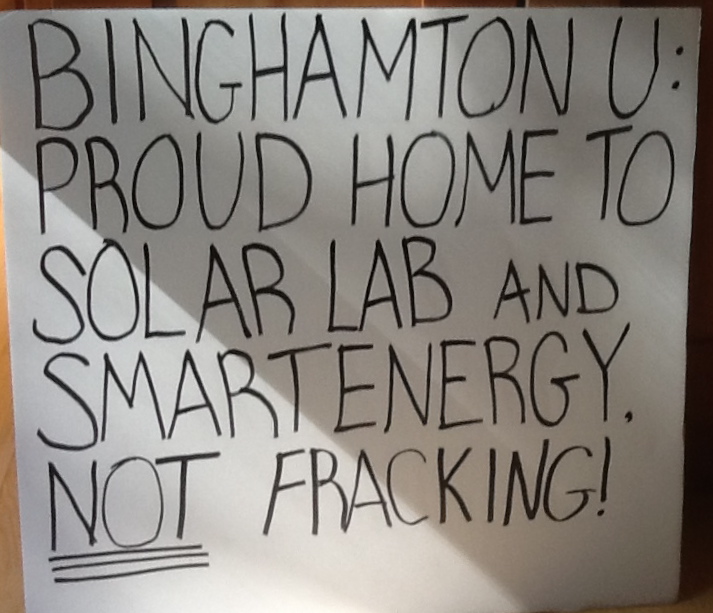
My sign - side one
My sign – side one

I spend a fair, some might say inordinate, amount of time on the fight to keep fracking out of New York State and to limit and end its use elsewhere. I frequently write comments on articles about it, a small fraction of which I share here at Top of JC’s Mind or on Facebook.  (For those who don’t know, fracking is the shorthand name for a process that extracts liquid and gaseous hydrocarbons from rock by using a mix of water, sand, and chemicals at extremely high pressure to fracture the rock.  Tons of information about environmental and health effects are available here: http://concernedhealthny.org/wp-content/uploads/2014/07/CHPNY-Fracking-Compendium.pdf )

I also attend events, rallies, and meetings when I can.  Fracktivists (or fractivists, a spelling I don’t use as often because people sometimes glance at it and read it as fascists, which takes their mind in a totally wrong direction) in New York have taken to showing up with signs asking for a ban on fracking whenever Governor Cuomo appears in public, usually on his way to an event that has restricted access.  This bird-dogging, as it is called, has become even more important in the run-up to the November election.

While Cuomo claimed that, as governor, he would keep an open public calendar, he has taken to keeping his schedule secret until the last possible moment. Thus, it wasn’t until late Wednesday evening that we got word that the governor would be arriving at Binghamton University at 11:00 AM Thursday.  Isaac, our intrepid community organizer – did you know that community organizers can become president some day? – quickly got the word out and about twenty of us showed up, signs in hand, to greet the governor’s motorcade and chant “Ban Fracking Now!”

As important as it is for Cuomo to see us wherever he goes, it is equally important that members of the press talk to us.  We had three television stations, public broadcasting radio, and the local newspaper taking interviews.  We were happy that Dr. Sandra Steingraber was among our number that day.  She is a biologist and public health expert who is currently at Ithaca College, a nationally and internationally known expert in toxic impacts of industrial pollution who is spending the lion’s share of her time and effort these days in the fight against fracking.  All the media outlets interviewed her.  Here is a sample of coverage that we received:  http://www.binghamtonhomepage.com/story/d/story/fractivists-protest-gov-cuomos-visit/34621/XNJzJy-Dkk-O7Wrr4WZOig.

We have been at this for several years and may be at it for several more.  It’s tough to fight an industry that spreads its huge wealth around to politicians to keep our country using polluting, climate-killing fossil fuels, but we have to keep fighting because it is so important to our present and future.

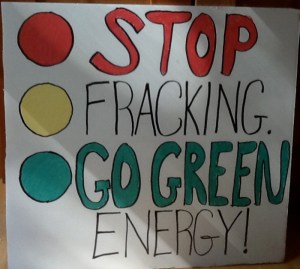
My sign - side two
My sign – side two

Three years later…

Three years ago, our home was still without power after the flooding caused by the ten inches of rain from tropical storm Lee, falling on ground already saturated by hurricane Irene a few days before.  Standing water from the flooding was two blocks away.  Flooded basements were a block away. If we had not had a generator to keep our sump pump going, we would have wound up with at least several inches of water in our basement. It was a record flood of the Susquehanna in our town and the tributary creek behind our house nearly overtopped the flood wall that is designed to direct the water to the undeveloped flood plain on the other bank.

There are segments on the local news about the anniversary and saying that the area is almost recovered, glossing over the fact that property buyouts only became available to people in local towns after hurricane Sandy devastated the coast. Demolitions only began in earnest this spring and are still continuing.

There will be no recovery for those who left the area permanently after longtime homes were destroyed. Some businesses closed permanently in the aftermath.  Only some of the infrastructure repairs hae been completed.

One of the more disturbing elements of the situation is that there has been little to no preparation for the next severe flooding event which is sure to come with the increased threat of heavy rain that goes along with global warming.  We should be restoring wetlands along the river and its tributaries and re-designing our storm drainage and sewage systems which caused so much trouble in the last two record floods that have occurred in the last ten years. Work also needs to be done with our water system and electrical system to make them more robust in emergencies.

Yes, it is expensive to do these things, but more expensive not to do them and to be cleaning up and rebuilding – again – after the next flood.

~~~~~~~~~~~~~

Personal note:  I haven’t been posting much lately because I managed to get pretty sick. I’m finally bouncing back and hope to have a few more posts out over the next week. Fingers crossed.


Women’s Equality Day

Ninety-four years ago today, women in the United States were finally accorded the right to vote in every state and in federal elections. It was a long time coming, starting out with Abigail Adams reminding her husband John to “remember the ladies” during the early days of the republic and progressing through generations of women working for the cause, including Elizabeth Cady Stanton and Susan B. Anthony. In commemoration, today is celebrated as Women’s Equality Day.

What is so disturbing is that equality is still a work in progress. The country is still struggling with basics like equal pay for equal work. Some people feel they should be allowed to interfere with women’s personal health decisions. Women have higher rates of poverty. More women are low-wage workers, even though women have higher education levels. The work that women have traditionally done caring for home and family is not considered part of the economy of the country, unless someone else is being paid (poorly) to do it. Women are in only a small portion of leadership roles in government, companies, and educational institutions. Few jobs offer the flexibility that women want to both make a living and have a life.

Policies that would help bring greater equality to women would help men, too. Many men would benefit from greater workplace flexibility and initiatives such as paying a living wage. When will we celebrate a Women’s Equality Day in recognition of having achieved that goal, instead of as a commemoration of women’s suffrage?


What I meant to say was…

“You keep using that word. I do not think it means what you think it means.” – Inigo Montoya in The Princess Bride

I try to be clear when I write prose – poetry is not as straightforward by design – but I am running into a problem. I tend to use words assuming readers will apply standard dictionary definitions, but I am finding myself increasingly having to explain at length what I mean by a certain term, so as not to be misinterpreted, as I did in my recent post My (Feminist) Story.

I do understand the difference between connotation and denotation, but it is a pity that many words that usefully describe philosophical or political views have become so skewed from their dictionary definition as to be unusable in practical terms. For example, the words “liberal” and “progressive” are heard more often as epithets than as accurate descriptors of actual policies. Past conservative presidents like Richard Nixon would now be considered liberal, given the positions of those who now describe themselves as conservative.

The word whose misuse most disturbs me is “science.” Science is about data, evidence, observation, reason, leading to conclusions consistent with facts and repeatable by other scientists. In order for papers to be published in scientific journals, they first must be reviewed by peers with knowledge of the field to ensure that the study’s procedures and conclusions meet research standards. Yes, there are studies that later need to be withdrawn when errors are found after publication, but that is rare.

I frequently write comments on news articles about unconventional fossil fuel extraction including “fracking,” renewable energy, and climate change. In my home state of New York, we are in a continuing battle over whether or not high volume hydraulic fracturing will be permitted. The governor has said that science will be the determining factor. The problem is that both sides say they have the science on their side.

The pro-fracking side has industry studies, which are almost never subject to peer review, bold pronouncements from the industry and their allies that fracking is safe, exemptions from key environmental provisions that apply to other industries, gag orders on court settlements of damage claims, and regulatory agencies that are a revolving door to the industry and that use subcontractors that also work with the industry to draft environmental review documents and regulations.

What we on the anti-fracking side have is – well – science. There was a trickle of studies at first, because scientific study takes time with additional time needed for peer review, but there have been more and more studies, especially in the last eighteen months, documenting environmental impacts on air, water, biosphere, climate, and public health. There is a new compendium of research on fracking here. (I can’t resist posting the link to the compendium at every available opportunity.)

Anyone who knows the definition of science should be able to tell which side is using science in their argument. I can understand that some people who are hoping to profit from fracking might delude themselves into believing the industry over the scientists. I don’t understand the press giving equivalency to the remarks of a peer-reviewed independent scientist and an industry spokesperson/propagandist.

The press should be clear with the definition of science. I know it has become common for politicians at all levels of government to say “I am not a scientist” as an excuse not to understand issues such as climate change. Frankly, people do not need to understand all the intricacies of scientific inquiry to believe a strong scientific consensus. They do need to understand the definition of science and to discern what meets the standards of science and what does not.

One-Liner Wednesday – Bernie Sanders

“A nation will not survive morally or economically when so few have so much, while so many have so little.”
– United States Senator Bernie Sanders (Independent- Vermont)

Join in Linda’s One-Liner Wednesday: http://lindaghill.wordpress.com/2014/07/23/one-liner-wednesday-writers-block/

Obama’s “All of the Above” Energy Plan

I just finished reading this article about how over 20 billion dollars of US government subsidies are directing at the fossil fuel industry and how the “all of the above” energy strategy is a failure from a global warming perspective.

It reminded me of the letter I wrote to President Obama after he visited Binghamton University in August 2013.

Today has been a heavy commenting day on fracktivist issues. You can all breathe a sigh of relief that I haven’t blogged them all, too. (If anyone is truly interested, I did cross-post a couple of my comments to Facebook, so I have access to links which I will share in comments, if desired.)

Fracktivist flurry

There has been an uptick in my fracktivist activity lately. This latest activity burst started with the recent New York State Court of Appeals decision upholding the home rule rights of towns in the state to ban unconventional drilling within their borders by using their zoning/land use powers.

There followed a lot of commenting on articles in the press about the decision and also about some important new scientific studies that have been published this month, along with the usual guest viewpoints and letters to the editors that need support or fact-checking.

Earlier this evening, I attended my town board’s meeting, along with a group of fellow residents who have been asking the board to consider a moratorium for years now. Given that the board no longer has the excuse of being afraid that they will be sued, we decided to bring it up again during the open comment period near the end of the meeting.

There were at least fifteen speakers for a town moratorium or ban and only three for drilling if/when the state lifts its moratorium. I even spoke, which is unusual as I prefer to communicate by writing rather than public speaking.

The frustration was that the board wouldn’t answer any questions that we asked. They are beholden to some of the large landowners and people in the trucking and construction business, so they pretend that it is all just a matter of preference, not a matter of science and public safety.

I asked one of the leaders of the anti-frackers how she thought it went, as I really wasn’t sure. She thought it went as well as it could have under the circumstances.

I guess – for tonight – that will have to do.