One-Liner Wednesday – compassion

“Compassion, in which all ethics must take root, can only attain its full breadth and depth if it embraces all living creatures and does not limit itself to mankind.”
– Albert Schweitzer

Join us for Linda’s One-Liner Wednesday:  http://lindaghill.com/2015/04/22/one-liner-wednesday-like-a-rolling-stone/

SoCS: peace through justice

I’ve recently joined a new organization, the Catholic Peace Community of the Southern Tier. There are people from several different parishes and we are hoping to build peace through working on different social justice areas.

Our first activities are dealing with the environment and climate change. One of the main tenets of Catholic social justice teaching is care of creation. Also involved are other tenets, such as the protection of the most vulnerable. Those who are living in poverty are much more likely to be subjected to pollutants and also more likely to be impacted by severe weather and sea level rise, as they live in vulnerable areas without strong shelter and do not have the means to relocate out of harm’s way.

We are looking forward to Pope Francis’s upcoming encyclical on the environment and will study the document when it is released in the late spring or early summer. Then we hope to get the word out about the encyclical not only to Catholic parishes but also to the general public in advance of the Paris climate summit in December.

Our first public event is on the 25th of this month when we will have a table at EarthFest.  Pope Paul VI said, “If you want peace, work for justice.” We hope to build peace by working on various justice issues, but I am glad that we are starting with this timely work for ecojustice.
*****

Linda’s prompt for Stream of Consciousness this Saturday is: “piece/peace.” To join in the fun, visit here:  http://lindaghill.com/2015/04/17/the-friday-reminder-and-prompt-for-socs-april-1815/

socs-badge

Drought, farms, and climate change

On the morning news, I heard the staggering statistics that California, which is in extreme drought, uses 80% of its water for agriculture, growing a third of the US supply of fruits and vegetables. It has already taken some farmland out of production or substituted crops that use less water. Meanwhile, it is in its fourth year of drought with snowpack under 5% of normal. As in over 95% of normally expected runoff water will not be there this year.

This should be setting off all kinds of alarm bells across the country. We need to shift our food production to more local areas and sustainable practices. Now, not in some distant future. We need to change our expectation of what foods we eat in which season of the year. When I was growing up, we ate fresh sweet corn in mid- to late-summer, when nearby farms were harvesting. We would prepare extra corn, cut it off the cob, and freeze it to eat at other times of year. We need to get back to this sense of eating fresh foods locally and preserving the extra produce to eat later rather than expecting California to send us strawberries in February. Certainly some crops, like citrus fruits, will not grow throughout the country, but others, like salad greens, can be grown close to where they are consumed, even in northern urban centers in winter where they can be grown indoors.

During the long slog fighting against shale gas development in New York State, I used many arguments against various aspects of this industrialization of our state. One of them was that, in this time of shifting climate, we needed to preserve our New York farms and forests for food production. Much of the farmland in the US is projected to have major droughts and heat waves as atmospheric carbon increases, including California and the Great Plains/Midwest farm belt. The Northeast, while expected to warm, is not expected to have severe issues with water supply. New York must assiduously protect its soils, water, and air from pollution in order to feed itself and other states as climate stressors increase.

No good deed goes unpunished

My recent entry in the “No good deed goes unpunished” category is my decision to heed the call to post comments to this article – in the Wall Street Journal, no less.  Before you go clicking on the link, I’ll warn you that it may not open if you are not a subscriber. Actually, I’m not a subscriber either, but often you can read articles if you click through a link posted through social media. That is how I can get through the paywall to comment. At any rate, the article is about how a few towns in the Southern Tier of upstate NY, including mine, are looking into seceding from New York to join Pennsylvania so that they can get permits to use high volume hydrofracking to extract shale methane from beneath their land.

Which is a totally bogus concept on sooooooo many levels.

I took time to formulate a comment, specifically as a resident of this area, not thinking about the prospect that I would get replies sent to my email. While I originally regularly responded to replies to my comments on fracking, I gave it up months ago to protect myself from some nasty personal attacks. They still got posted, of course, but I didn’t see them. I didn’t go back to articles on which I had commented and assiduously refused to click on the Facebook notifications generated by Gannett papers and other sites that use FB as a commenting platform, supposedly to increase civility. I also seldom read others’ comments when I was posting.

Getting replies to my WSJ comment by email reminded me of several things.
1.)  Many people who comment are snarky.  One respondent took great glee in explaining that there is this thing called the Internet with a search engine called Google and therefore he could tell I was lying because the Marcellus shale underlies so much of NY  that it was obvious there was all this methane just waiting to be extracted. Which leads to…
2.)  Many people who comment don’t know what they are talking about. So, when I explain that the shale needs to be a certain thickness, depth, and thermal maturity to contain significant amounts of recoverable methane, they go on as though none of that matters.
3.)  Some people refuse to believe a fact if it doesn’t go along with their political viewpoint.
4.)  Some people don’t think there should be any taxes, but they seem to want all the things that tax money provides for their community, state, and the country.
5.)  Responding to replies is a major time sink.  I spent hours and hours on this one article commentary, which reminded me of how many hours I used to spend on this. While there is still a fair amount of commentary that I participate in on fracking and climate change, I am grateful not to be spending so much time on it as I did before the impending NYS HVHF ban was announced.

And, for the record, no New York town is going to be leaving the state.

Lessons from Selma, Ferguson, and Seneca Lake

This morning I watched coverage on the 50th anniversary of Bloody Sunday, the first attempt at the voting rights march in Selma, Alabama. I am re-blogging my post from January after I saw the film “Selma” which draws together the story of the march with recent events.
– JC

Joanne Corey's avatarJoanne Corey

When the events depicted in the film Selma occurred, I was a four-year-old girl in rural New England.  I do remember seeing Dr. King on the news when I was a bit older and definitely remember his assassination in 1968 in the midst of the Memphis strike by black public works employees who were facing discrimination.  It was incomprehensible – then and now – that a Nobel Peace Prize laureate and leader of such an important social movement could have been only 39 when he died. Because he was such a force and martyred so young, his legacy became a legend, masking his complexity as a human being. While the public life of some of those around King, such as Ambassador Andrew Young and Rep. John Lewis, was decades long and vital to keeping the civil rights movement going forward while remembered its momentous, if painful, past, King’s life has…

View original post 746 more words

“Healing the World”

I have spent countless hours over the last several years working on the issues of shale oil/gas fracking, climate change, and renewable energy, primarily through online commentary.  Although I make my case using science, real-world experience, sociology, and economics, much of my personal energy for this work comes from my grounding in the principles of Catholic social doctrine and my calling to live them to the best of my abilities.

Earlier this month, I was very grateful to attend a workshop/retreat entitled “Healing the World:  One Step at a Time” led by the Rev. Dr. Bruce Epperly.  It was designed as a time to reflect on challenges to our natural and human environment as we in the Christian churches prepare for the Lenten season. The timing was perfect for me because just as we in New York received the fantastic, unexpected news of a planned ban on high volume hydrofracking (HVHF), I developed a case of shingles, which kept me from participating in the spontaneous celebrations that happened in the following days.  It was a blessing to have the opportunity to see some of the other people who had worked so hard on this cause and to meet others who were also working on caring for creation, including humanity, and to renew our hope as we continue our work.

There were so many important reminders:
To remember to take time away from activity to reflect, pray, and renew.
To not let opponents become dehumanized in our own minds, which I manage quite well with my environmental advocacy, even in the face of derogatory comments directed at me, but less well when it comes to confronting those who commit atrocities such as the terror attacks in France or the horrible massacres and kidnappings by Boko Haram in Nigeria.
To not get caught in the either/or of dualism.
To realize that one small action or prayer can have an effect in the world that we can neither predict not know, a principle that played out for us in the battle against HVHF in New York, where hundreds of thousands of individual actions added up to what had seemed to be an improbable, or even impossible, victory.
To challenge what is in need of reform while offering an alternative path that is good, sustainable, life-giving, and cognizant of the interdependence of creation, which, while I understand that to be within the concept of God-who-is-Love, exists both within and apart from spiritual traditions.

One of the great gifts of the workshop was a special video message to us from Bill McKibben, co-founder of 350.org and one of the world’s leading voices on climate change issues.  I had expected a somewhat generic welcome and acknowledgment but was stunned at how personally Bill spoke to us. It was obvious that he knew our area of the country, calling Interstate 88 “Warren Anderson’s driveway”, which is an inside, local joke, and talking about our beautiful rolling hills and our history of technological innovation. He recognized the immense work of the Broome County fractivists, which was very meaningful to me because, however hard we worked to get our message out there, it seemed that the public perception of our county was that our pro-fracking politicians were speaking for their constituents rather than for themselves, the JLCNY, and the fossil fuel and other business interests who gave them campaign contributions. While I will always be grateful to our allies in Ithaca and the Catskills and NYC and around New York State and our beleaguered friends from PA who fought so hard for our cause, it was heartening to know that Bill McKibben recognized our efforts here as vital to the victory.

Bill went on speaking to us from both an environmental and a faith perspective, challenging us to build new sustainable systems. I appreciated him mentioning building up local agriculture, in which initiatives are already underway with more to come, and alternative energy, another area in which we have already made advances and hope to build upon rapidly now that we no longer have the threat of HVHF’s industrialization and pollution making our homes unpleasant or unlivable.  I think everyone in the room loved when Bill spoke of taking “energy from above, rather than below.”  Such a potent metaphor.  No to fossil fuels. No to negativity. Yes to wind, water, and sun. Yes to responsible use of biomass/biofuels.  Yes to heat pumps (Even though the geothermal ones probably fit in the “below” category, I’m claiming them for the surface.) Yes to the energy of people taking action to protect the environment and to protect people, especially those most vulnerable to the ravages of poverty and climate change. Yes to the power of Divine Love, which we envision as coming to us from above, but which also surrounds us in creation and imbues us with energy to protect and cherish every being and every thing.

Bill McKibben said, “People of faith bring their own reasons.”  I thank him, Dr. Epperly, all the workshop participants, the Peace with Justice Committee of the Broome County Council of Churches and all the other sponsors for reminding me of my reasons and renewing my energy to continue to serve God in love through cooperating with others to care for creation – the environment, creatures, and humanity.

This post is part of Linda’s Just Jot It January:  http://lindaghill.com/2015/01/01/just-jot-it-january-pingback-post-and-rules/

Lessons from Selma, Ferguson, and Seneca Lake

When the events depicted in the film Selma occurred, I was a four-year-old girl in rural New England.  I do remember seeing Dr. King on the news when I was a bit older and definitely remember his assassination in 1968 in the midst of the Memphis strike by black public works employees who were facing discrimination.  It was incomprehensible – then and now – that a Nobel Peace Prize laureate and leader of such an important social movement could have been only 39 when he died. Because he was such a force and martyred so young, his legacy became a legend, masking his complexity as a human being. While the public life of some of those around King, such as Ambassador Andrew Young and Rep. John Lewis, was decades long and vital to keeping the civil rights movement going forward while remembered its momentous, if painful, past, King’s life has been shown on film only as a secondary character until the release of Selma a few weeks ago.  The film shows how complicated things were for Dr. King during the 1965 voting rights struggle that led to the march from Selma to Montgomery.

Daniel Oyelowo portrays the complexity of Dr. King, trying to balance political, religious, tactical, family, personal, and interpersonal forces in situations where even the best possible course risked injury and death. Carmen Ejogo as Coretta Scott King underscores the precariousness of their family’s life and the strength of will that it took for her to keep the family together in the face of betrayal, wiretapping, and threats against all the family members, including their four children. Although based on actual events, the film is not a documentary and the script does not include King’s own public speeches, because his sons would not give the filmmakers permission to use them. Despite that, the speeches in the film sound like those of Dr. King and Oyelowo delivers them with passion.

Throughout the film, I was reminded of how far we have come as a nation – and how many challenges or even regressions are still to be rectified. While I am grateful that voter registration forms no longer ask for an applicant’s race, we have recently seen some of the protections of the Voting Rights Act scaled back and the advent of new voter ID laws  and changes in polling hours and places that make it difficult for older voters, people of color, and those in low-income communities to vote as they are entitled to as US citizens.

In Selma, we see police arrest, beat, and use teargas against peaceful protestors. We sometimes see this happen now, too, in Ferguson, MO and other cities protesting against racial problems with policing. We saw police use similar tactics during the breakup of the Occupy movement. It’s sad that I have cause to worry more about my nephews who are of color being stopped or profiled by police than I do about my nephew who is white.  In the fifty years since the march from Selma to Montgomery, we should have progressed more than we have.

Near the beginning of the film, a number of protestors, including Dr. King, are jailed for trying to enter the courthouse through the front door. I immediately thought of the members of We Are Seneca Lake and their supporters, who have been barred from entering the court room and the town hall in Reading, forced to stand out in the frigid cold, not even able to wait in heated cars because the police have banned parking near the court. Non-violent civil disobedience to keep Crestwood from expanding fossil fuel storage in the salt caverns near the drinking water supply of 100,000 people has turned into over 180 arrests with hearings by a judge who refuses to recuse himself despite industry ties and who is violating the legal rights of the defendants.

There are many tactical/political conflicts in the film. What should be handled by federal, state, or local governments? When is the right time for a march or civil disobedience or legislation? When is the right time to bring in allies? What is the relationship between faith values and government? Who makes the final decision on strategy?  These factors and others have been playing out for me over the last several years in our fight against high volume hydrofracking in New York State.  While I am not in a leadership position, I have interacted with many different organizations and leaders with differing opinions on the right way to proceed. Should we work for a continued delay or a ban? Legislative action or executive/regulatory action? Work on local bans or just on the state level?  Argue on scientific grounds, environmental grounds, economic grounds, or moral grounds? I admit that my own approach was to throw everything I could at the problem, changing tack depending on the circumstance.

While we were thrilled but stunned by the Dec. 17 announcement of an impending state-wide ban , we still have a lot of work to do on infrastructure and waste disposal projects in the state, continuing work to keep the ban in place, accelerating our roll-out of renewable energy and efficiency projects, and helping our allies to stop unconventional fossil fuel production in their states, too.

As in Selma, any victory is only partial and leads to more work.  Keep on keeping on.

http://lindaghill.com/2015/01/01/just-jot-it-january-pingback-post-and-rules/

Defending Broome County

While it would seem that the impending fracking ban in NY would cut down on my incessant commenting on shale oil/gas issues, there has instead been a flurry of reports and editorials to answer, such as this one. Yes, I got carried away, but it really upsets me when people in other parts of the state misrepresent my home area. My (very long) comment to an editorial in the Syracuse Post-Standard:

I live in a Broome County town bordering PA and this editorial’s contention that we are looking forlornly across the border at prosperity in PA is dead wrong. Across the border in PA there is shale gas drilling going on, but a lot of negative impacts. Besides the health problems that have been documented in the peer-reviewed scientific literature, there are socioeconomic problems with high rents, increased crime rates, inability to insure, finance, or sell homes near wells, plummeting royalty payments, noise pollution, light pollution, increased rates of homelessness, increased truck traffic, accidents, liens placed on properties when drilling companies didn’t pay their subcontractors, and strains on medical and emergency services. People who wanted to live in a nice country setting are now in a noisy industrialized setting. I am grateful that these problems won’t be coming to my town.

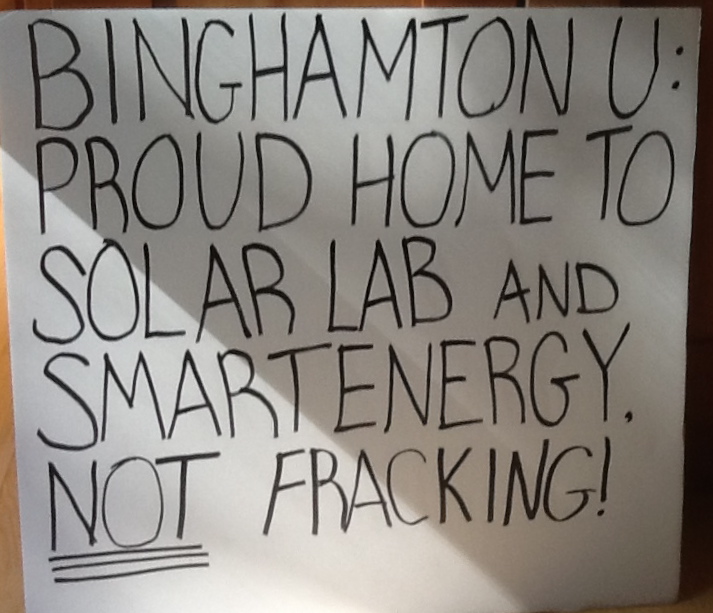
Meanwhile, I think the editors should take a trip to Greater Binghamton and look around. It is not the poverty-stricken, despairing place you seem to think it is. Two of our biggest employment sectors are medical, anchored by Lourdes and two UHS hospitals, and education, anchored by BInghamton University and SUNY-Broome, with a new graduate school of pharmacy about to be built. We still have high tech jobs, though fewer than we once had, with IBM, Link flight simulation, and BAE, among others. Our most exciting new plans in high tech are in the the area of renewable energy/energy storage. Binghamton University’s Solar Lab has been conducting research for a number of years already and has developed a thin-film solar cell that uses only common elements without any rare earth elements. Two large projects are currently being built, a High-Tech incubator in downtown BInghamton and the SmartEnergy Center on the Vestal campus. The combination of these should expand our high-tech/energy sector in the future. Meanwhile, Broome County is a state leader in energy efficiency upgrades through NYSERDA Green Jobs, Green NY and in expansion of solar for homes and small businesses. The energy projects alone have created many times more jobs than shale drilling would have, without the pollution and industrialization of residential and rural areas that would have occurred with drilling.

And about the potential of shale drilling in NY. DEC had to weigh possible economic benefit versus potential costs of drilling to the state and to residents; it’s part of its job. The economic impact section of the draft SGEIS made a number of faulty assumptions, including that shale plays are uniformly productive, that large swaths of NYS would be viable to drill, and that the wells would produce for thirty years. Data from PA and other areas with shale drilling have shown that there are distinct sweet spots in shale plays that are high-producing, with the rest of the play being much less so. Most of the shale in NYS is too thin and too shallow to contain large amounts of methane and there are not natural gas liquids, which have a better economic profile than dry methane, at all. Shale wells of all kinds have very steep decline curves, with the vast majority of the gas being produced in the first 18 months and most of the rest in the following 3-6 years, much shorter than the 30-year timeframe the SGEIS assumed. The industry has done some test wells in various parts of the Marcellus and Utica in NY – and didn’t think it was worth applying for permits. The major companies in their own maps of the play never showed the potential drilling area going much over the NY border. Production numbers in PA bear this out; once you head north from the NEPA sweet spot, production goes way down. Because HVHF wells are so expensive to drill and frack, methane prices would have to more than double to break even in southern Broome County and the figures just get worse from there. It’s time to stop pretending that fracking – or casinos – are the future of the Southern Tier and get to work on building up renewable energy and conservation, while expanding on education, medical, high-tech, agriculture, next-gen transportation, recreation, and tourism jobs.

http://www.syracuse.com/…/new_yorks_hydrofracking_ban_drape…

Not One Well!!!!!!!!

Hours ago, New York State Governor Andrew Cuomo announced that high volume hydraulic fracturing will be banned in New York State. I am thrilled with the news, if a bit dazed. After spending countless hours on this issue over the last several years, the whole fractivist community is relieved and celebrating!

I will get to slow down on commentary a bit, but I’m sure that I and other NY fractivists will continue to fight expanded fossil fuel infrastructure and waste disposal in NY, as well as continue to help other states to rein in the pollution and health impacts that fracking is causing.

But now, from my home in New York on the PA border, I can proudly state:  Not One Well!

Giving thanks for no fracking

Dear Governor Cuomo,

Happy Thanksgiving! This year, I am thankful that there has been no shale gas drilling using high-volume hydrofracking in New York State, especially in Vestal, my hometown.

I’m also thankful that this has been the year that many independent scientists have published peer-reviewed work elucidating the damage that shale gas and oil extraction, processing, transport, use, and waste disposal are doing to human, environmental, and planetary health.

The work of climate scientists makes the high stakes abundantly clear. Humans must stop burning fossil fuels as soon as possible, especially unconventional fossil fuels which have a higher greenhouse gas emission burden than conventional fossil fuels.

Therefore, I call on you as governor to enact a permanent ban on unconventional fossil fuel extraction in New York State and to end the expansion of fossil fuel infrastructure and importation of waste products from shale drilling.

Instead, New York State must go all in for renewable energy and efficiency. Wind, especially off-shore wind, solar, electric grid upgrades, biomass, non-food-crop biofuels, heat pumps, geothermal, advanced battery storage, and other emerging energy technologies are what New York, the United States and the world need for our future, not an ever more desperate and expensive scramble for dangerous fossil fuels.

Sincerely,
Joanne Corey