
I am now on Ello as joannecorey so if anyone is so inclined, follow me and I will follow you back. I’m just learning my way around but am interested in participating with this new, ad-free platform.
Category: comment

What I meant to say was…
“You keep using that word. I do not think it means what you think it means.” – Inigo Montoya in The Princess Bride
I try to be clear when I write prose – poetry is not as straightforward by design – but I am running into a problem. I tend to use words assuming readers will apply standard dictionary definitions, but I am finding myself increasingly having to explain at length what I mean by a certain term, so as not to be misinterpreted, as I did in my recent post My (Feminist) Story.
I do understand the difference between connotation and denotation, but it is a pity that many words that usefully describe philosophical or political views have become so skewed from their dictionary definition as to be unusable in practical terms. For example, the words “liberal” and “progressive” are heard more often as epithets than as accurate descriptors of actual policies. Past conservative presidents like Richard Nixon would now be considered liberal, given the positions of those who now describe themselves as conservative.
The word whose misuse most disturbs me is “science.” Science is about data, evidence, observation, reason, leading to conclusions consistent with facts and repeatable by other scientists. In order for papers to be published in scientific journals, they first must be reviewed by peers with knowledge of the field to ensure that the study’s procedures and conclusions meet research standards. Yes, there are studies that later need to be withdrawn when errors are found after publication, but that is rare.
I frequently write comments on news articles about unconventional fossil fuel extraction including “fracking,” renewable energy, and climate change. In my home state of New York, we are in a continuing battle over whether or not high volume hydraulic fracturing will be permitted. The governor has said that science will be the determining factor. The problem is that both sides say they have the science on their side.
The pro-fracking side has industry studies, which are almost never subject to peer review, bold pronouncements from the industry and their allies that fracking is safe, exemptions from key environmental provisions that apply to other industries, gag orders on court settlements of damage claims, and regulatory agencies that are a revolving door to the industry and that use subcontractors that also work with the industry to draft environmental review documents and regulations.
What we on the anti-fracking side have is – well – science. There was a trickle of studies at first, because scientific study takes time with additional time needed for peer review, but there have been more and more studies, especially in the last eighteen months, documenting environmental impacts on air, water, biosphere, climate, and public health. There is a new compendium of research on fracking here. (I can’t resist posting the link to the compendium at every available opportunity.)
Anyone who knows the definition of science should be able to tell which side is using science in their argument. I can understand that some people who are hoping to profit from fracking might delude themselves into believing the industry over the scientists. I don’t understand the press giving equivalency to the remarks of a peer-reviewed independent scientist and an industry spokesperson/propagandist.
The press should be clear with the definition of science. I know it has become common for politicians at all levels of government to say “I am not a scientist” as an excuse not to understand issues such as climate change. Frankly, people do not need to understand all the intricacies of scientific inquiry to believe a strong scientific consensus. They do need to understand the definition of science and to discern what meets the standards of science and what does not.
Share this:

Slow recovery
Nearly every night on the news, there is coverage of devastation in some US state due to flood, wildfire, mudslide, tornado, hurricane, or ice/snowstorm. Solemn footage of some reporter surrounded by a tangle of building debris or downed trees and powerlines. If the disaster is widespread enough, the coverage may even go on for a couple of weeks. Invariably, though, the reporters and national attention move on to the next disaster scene, masking the truth that recovery, if possible, takes months or years.
I drove today though one of the neighborhoods in my town which was most severely affected in the September 2011 flood of the Susquehanna and its tributaries in the Southern Tier of New York. We had received ten inches of rain when the remnants of tropical storm Lee fell on ground already saturated by the fringe of hurricane Irene days before. First, there was flash flooding of the creeks, followed by record flooding of the Susquehanna. Some photos we took are here:
https://www.facebook.com/media/set/?set=a.2019747698814.2103178.1397554070&type=1&l=f4365bbc43
https://www.facebook.com/media/set/?set=a.2016067046800.2103029.1397554070&type=1&l=3df89ce2ba
You won’t see any of the neighborhood pictures here because it was cordoned off. Not even residents were allowed in for days. Even after the river had receded and water had been pumped out of houses and basements, storm water and sewage from the broken infrastructure system flowed into the basements, re-filling them. Some houses had to be pumped out four or five times.
Some houses were condemned. Some were repairable, but homeowners, many who had lived in their homes for decades, weren’t able to withstand the stress of rebuilding and worrying if it would happen again. A few properties were abandoned, while others were sold to speculators for pennies on the dollar. Some people were able to repair their homes with the help of federal flood insurance, while others relied on non-profits, friends, relatives, and savings to rebuild. Other homes were put on the market, some in a livable state and some not, but buyers were hard to come by.
There had initially been a tussle in Washington over funding FEMA’s response to Irene/Lee, but that was resolved. New York’s state government was very little help to us.
It wasn’t until the federal funding battle after Superstorm Sandy that New York State went to bat for us so that our area finally was able to get buyouts for some of our damaged properties, getting partial compensation to property owners and funds for the towns to tear down the houses and convert them to green space. It was too late for many of the affected homeowners, but it has helped some, and transformed the neighborhood into what I saw today.
The street is a patchwork of occupied houses with tidy lawns next to homes for sale – some repaired and some, surrounded by tall grass and overgrown shrubs, still in their flood-damaged state – next to lots where houses were recently leveled, covered in straw to protect grass seed, next to larger-than-expected expanses of lawn where the demolitions were long enough ago for the grass to have grown in. The nursing home that flooded is still sitting empty; they are building a new home in another part of town.
It still saddens me every time I drive through. For the neighborhood, nearly three years later, recovery continues, but it will never be complete.
Share this:

belief vs. fact
A couple of hours after the elation of yesterday’s court decision upholding home rule in New York State, came the utterly convoluted US Supreme Court decision in the Hobby Lobby case. While there are thousands of words of talk and text on this ruling out there already, the aspect I want to weigh in on the collision of belief and fact that is in evidence in the decision.
The family that owns Hobby Lobby believes that a few of the forms of birth control mandated for coverage under the Affordable Care Act cause abortions. (They apparently didn’t believe this prior to the ACA when their employee health insurance plan covered these same items, but that is a different story.)
The fact is that these forms of birth control are not abortifaciant. The morning after pill will not abort a pregnancy. The IUD works chiefly by disrupting the activity of sperm. One of the best brief explanations of the facts I have seen is from Jamie Manson, writing in the National Catholic Reporter, here.
The US Catholic bishops make the same factual error in their public pronouncements in condemning the ACA because of the contraception mandate. It’s probably not a coincidence that the five Supreme Court justices who formed the majority in which belief trumped fact in the Hobby Lobby case are Catholic men. On the other hand, Catholic woman on the court Sonia Sotomayor and female-led Catholic organizations NETWORK, a national Catholic social justice lobby, and the Catholic Health Association, the largest non-profit health provider in the US, recognize that these contraceptive methods are not abortifaciant. NETWORK and CHA would never have advocated for the ACA’s passage if abortion were part of its provisions.
I am Catholic and well aware of my Church’s teaching on so-called artificial means of contraception and assisted reporduction. I also know that the vast majority of US Catholics reject these teachings and act according to their own consciences in making these personal decisions.
If one believes that contraception in general is immoral, that is your right and that is the choice you make for your own life. Employers – or anyone else for that matter – should not mandate assent to their personal religious belief on others. It makes absolutely no sense to inflict that belief on anyone when it flies in the face of scientific/medical fact.
I fear for our society when belief trumps facts. I hear this over and over in the “debate” on human-induced climate change. The science is settled. It is happening. There are reams of data showing it. Yet some persist in a belief that the world is cooling instead of warming and that the cycle is a purely natural phenomenon. Their belief does not change the facts/science. They are demonstrably in error.
That the five Catholic men on the Supreme Court decided a case on a mistaken belief is highly disturbing. We can only hope that our dysfunctional Congress will enact legislation to correct the Court’s error before more damage is done.
Share this:

An OB/GYN writes to George Will about college rape
Dr. Jennifer Gunter wrote this powerful response to the recent George Will column about rape on college campuses. It’s easy to tell who is the wise voice of wisdom through personal experience and who is the voice of ignorance.
Share this:

A Solemn Thought for Saturday
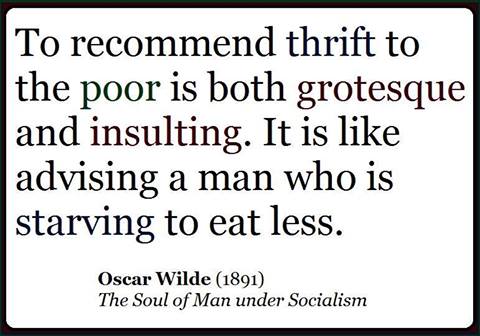
This is from an Austrailian blogger whom I follow. The Wilde quote applies across many times and places, including now in the US with rising poverty and income inequality while rich individuals and corporations don’t pay their fair share in taxes and receive subsidies and other tax breaks. Meanwhile, cuts are made to needed assistance for housing, food, education, and other services for the low- and middle-income folks.

 Thank you to Asylum Seeker Resource Center here in Australia for this quote.
I find it apt considering the circumstances surrounding the current budget and even more so considering the resources you provide that should be provided by our government. So thank you for this quote and thank you for the work that you do.
Share this:

HarsH ReaLiTy Challenge – Got an Opinion?

One of the blogs I follow has issued this opportunity for reblogging opinion posts. Read his post and see if you want to take up the challenge.
JC
Share this:

Buffalo News fracking story comment
We are watching a recording of the Eurovision competition, so I decided to write a fracking comment on this: http://www.buffalonews.com/city-region/environment/a-border-tale-of-boom-and-bust-20140510
I live in Broome County in a town that borders PA. This article is misleading on a number of fronts, a few of which I will point out.
First, the PA counties are much more sparsely populated than the NY counties. Even if NY permitted HVHF, the number of jobs gained would be a drop in the bucket in terms of unemployment rate and might be offset by jobs lost in other sectors, such as tourism. The population density also would cut down how many wells could be drilled because there would need to be a lot of setbacks from homes, businesses, water sources, etc. In Broome County, the only part of the county that might be viable as methane prices rise is the southern part, which also has the highest population density and is served by a sole source aquifer.
Norse did not go bankrupt because of failed Marcellus leases. Most of its leases were for the Utica and other non-shale formations.It was engaged in vertically fracked wells and conventional wells; it just wasn’t very successful at it. http://www.cedclaw.org/news/norse-energy-whats-happening . Also, remember that vertical fractured wells in the Marcellus could have been drilled. A company could even have applied for a horizontal well if it had completed a site-specific environmental impact statement at its own expense, as other kinds of companies do for their projects.
Because I live on the PA border, I’ve seen the impacts on PA neighbors. For people who have lost their water wells, who have been driven out of their homes due to health impacts, whose homes have lost value due to noise and other kinds of pollution, who have been unable to re-finance mortgages or sell their homes because banks won’t take the risk of drilling operations to the property value, who have seen their royalty payments drop by 50, 70, even 90% due to companies’ deducting large amounts for expenses, discovering that mechanic’s liens have been placed against their deeds because drilling companies failed to pay their sub-contractors, who were victims of the increased traffic accidents, especially with industry trucks, who were victims of the increase in crime, including sexual assault, who lost their long-time rental home when the rents tripled – no statistics on job growth can make up for the losses they have suffered. I don’t want those stories repeated in my New York community.
Share this:

Bayou Corne sinkhole
I have been following the Bayou Corne, Louisiana sinkhole story since it began in 2012. Here is a link to a story on it from earlier this month from a local source: http://www.examiner.com/article/louisiana-s-bayou-corne-sinkhole-eats-well-pad-people-next
This morning a story about sinkholes was on CBS This Morning, which is a US national network news broadcast. They were doing a story on sinkholes and talked about the Bayou Corne sinkhole as though it was typical of other sinkholes around the country. They had to reference it in the report because research done in conjunction with it may be helpful in predicting ordinary sinkholes, but they should have pointed out that Bayou Corne is an industrial accident featuring hydrocarbon storage and a salt dome collapse, not an “act of God.”
My comment sent to CBS This Morning:
I am watching CBS This Morning on Thursday, April 24. You just aired a piece about sinkholes that twice referenced the Bayou Corne sinkhole in LA. You should have pointed out that this sinkhole was caused by the collapse of a salt dome being used for hydrocarbon storage. This is a totally different mechanism than the typical limestone dissolution and collapse that causes sinkholes in places like Florida. The Bayou Corne sinkhole is an industrial accident, which was preceded by tremors and release of methane and other hydrocarbons. It has resulted in the evacuation and now permanent re-location of 300 people. It is in no way just another sinkhole; it is a criminal act causing huge environmental damage by an irresponsible company, not a natural process. You should have pointed this out in your report.
Share this:

Fifth Anniversary of the ACA shootings
Last night, when the news broke about the shooting at Fort Hood, the first thought many people had was “not again.” Not again at Fort Hood, and not again in general.
The timing was especially poignant for those of us in the Binghamton NY area, because today marks the fifth anniversary of the American Civic Association shootings, in which fourteen people died, including the mentally ill gunman, and four were wounded.
Despite the tragic loss of life, the ACA shooting is usually not present in the list of mass shootings that gets recited in the media when the next horrible shooting comes along. Columbine. Virginia Tech. Aurora. Newtown. Fort Hood.
I am not saying that we should not be remembering these other mass shootings. We should, and we should be doing more to avert similar deaths and injuries in the future.
What I do find disturbing is that so many have forgotten about the ACA tragedy. I’ve spent a lot of time trying to figure out why.
I am afraid that the primary reason is that the gunman and most of the dead were immigrants. Most of them were gathered in one of the American Civic Association’s classrooms, taking a class to improve their English skills, when they were shot. They were from Vietnam, China, Pakistan, Iraq, Haiti, Brazil, The Philippines. Two were in Binghamton as visiting scholars. Others had been resettled in the area as refugees. The ACA is well-known in the area as a gathering place for immigrants to study English or prepare for citizenship tests. Several of those who were shot were employees or volunteers who had embraced this important mission. Somehow, though nearly all of us in the United States are descended from immigrants or are immigrants ourselves, the story of the ACA shootings did not embed itself into our minds as have some of the other tragedies that took place in schools or other public settings. I’m sorry to say that I think people see themselves or their grand/children as being just like those gathered in an elementary school or at a movie theater, but that they don’t see themselves as people from a different country, with a different skin color, speaking with an accent, working toward citizenship.
Five years on, I don’t want these people to have been forgotten. I want them to be remembered – and to be remembered as neighbors, as members of our community, as people like us.

 Joanne Corey