Where Pope Francis stands when it comes to women | National Catholic Reporter

Where Pope Francis stands when it comes to women | National Catholic Reporter.

I commend Father Tom Reese for writing this column. He makes a lot of good points, but I felt compelled to make the following comment:  “I don’t think that women are upset with Francis calling for a theology of women because they prefer to think of a theology of person. Rather, what upsets me and other women that I know is that there a decades of profound writings in feminist theology that Francis does not seem to even know exists. While we all welcome further work on this theology, we must acknowledge that a lot has already been accomplished, whether or not the clergy and other men of the church have been reading and studying it. Another instance of the men of the church not listening to the women’s viewpoint?”

No good deed goes unpunished

My recent entry in the “No good deed goes unpunished” category is my decision to heed the call to post comments to this article – in the Wall Street Journal, no less.  Before you go clicking on the link, I’ll warn you that it may not open if you are not a subscriber. Actually, I’m not a subscriber either, but often you can read articles if you click through a link posted through social media. That is how I can get through the paywall to comment. At any rate, the article is about how a few towns in the Southern Tier of upstate NY, including mine, are looking into seceding from New York to join Pennsylvania so that they can get permits to use high volume hydrofracking to extract shale methane from beneath their land.

Which is a totally bogus concept on sooooooo many levels.

I took time to formulate a comment, specifically as a resident of this area, not thinking about the prospect that I would get replies sent to my email. While I originally regularly responded to replies to my comments on fracking, I gave it up months ago to protect myself from some nasty personal attacks. They still got posted, of course, but I didn’t see them. I didn’t go back to articles on which I had commented and assiduously refused to click on the Facebook notifications generated by Gannett papers and other sites that use FB as a commenting platform, supposedly to increase civility. I also seldom read others’ comments when I was posting.

Getting replies to my WSJ comment by email reminded me of several things.
1.)  Many people who comment are snarky.  One respondent took great glee in explaining that there is this thing called the Internet with a search engine called Google and therefore he could tell I was lying because the Marcellus shale underlies so much of NY  that it was obvious there was all this methane just waiting to be extracted. Which leads to…
2.)  Many people who comment don’t know what they are talking about. So, when I explain that the shale needs to be a certain thickness, depth, and thermal maturity to contain significant amounts of recoverable methane, they go on as though none of that matters.
3.)  Some people refuse to believe a fact if it doesn’t go along with their political viewpoint.
4.)  Some people don’t think there should be any taxes, but they seem to want all the things that tax money provides for their community, state, and the country.
5.)  Responding to replies is a major time sink.  I spent hours and hours on this one article commentary, which reminded me of how many hours I used to spend on this. While there is still a fair amount of commentary that I participate in on fracking and climate change, I am grateful not to be spending so much time on it as I did before the impending NYS HVHF ban was announced.

And, for the record, no New York town is going to be leaving the state.

What Is the United States?

Most of my readers are from the United States, as am I. This post has some fun questions for you to weigh in about the US.

Jay Dee's avatarI Read Encyclopedias for Fun

Most of you are American.  I can safely say that, because more than 50% of the readers of this blog are American.  In 2014, Americans made up around 60% of the readers.  So, chances are you’re American.  If not, forgive me.  I’m not American, either.

This is the first post in a new series where I explore each country that my readers come from, starting with the biggest and going down to the smallest.  However, I need your help.  I’m going to provide the most basic information that you can find, but I want opinions from you.

Are you American?  Have you lived in the United States?  Or have you visited the United States?  Even if you aren’t, please read on.

320px-Flag_of_the_United_States.svgThe United States of America

It’s a big country.  With an area of 9,857,306 square kilometres, it’s the third largest country in the world.  It has a population of…

View original post 180 more words

Defending Broome County

While it would seem that the impending fracking ban in NY would cut down on my incessant commenting on shale oil/gas issues, there has instead been a flurry of reports and editorials to answer, such as this one. Yes, I got carried away, but it really upsets me when people in other parts of the state misrepresent my home area. My (very long) comment to an editorial in the Syracuse Post-Standard:

I live in a Broome County town bordering PA and this editorial’s contention that we are looking forlornly across the border at prosperity in PA is dead wrong. Across the border in PA there is shale gas drilling going on, but a lot of negative impacts. Besides the health problems that have been documented in the peer-reviewed scientific literature, there are socioeconomic problems with high rents, increased crime rates, inability to insure, finance, or sell homes near wells, plummeting royalty payments, noise pollution, light pollution, increased rates of homelessness, increased truck traffic, accidents, liens placed on properties when drilling companies didn’t pay their subcontractors, and strains on medical and emergency services. People who wanted to live in a nice country setting are now in a noisy industrialized setting. I am grateful that these problems won’t be coming to my town.

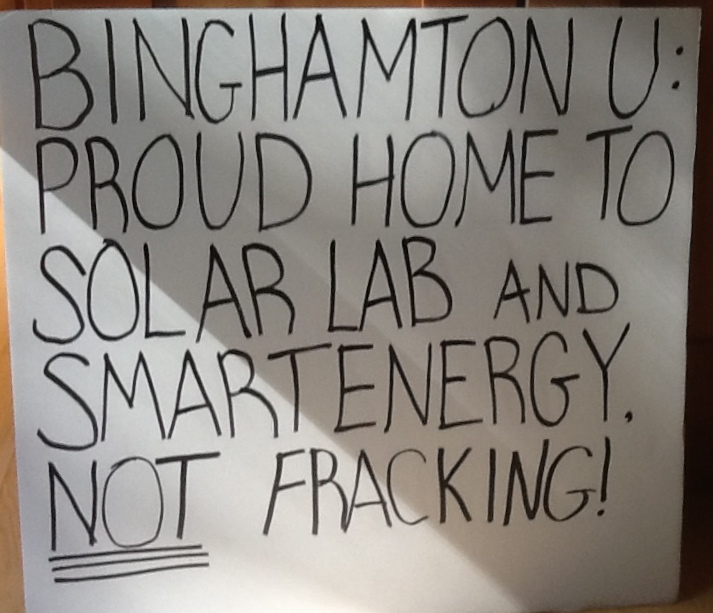
Meanwhile, I think the editors should take a trip to Greater Binghamton and look around. It is not the poverty-stricken, despairing place you seem to think it is. Two of our biggest employment sectors are medical, anchored by Lourdes and two UHS hospitals, and education, anchored by BInghamton University and SUNY-Broome, with a new graduate school of pharmacy about to be built. We still have high tech jobs, though fewer than we once had, with IBM, Link flight simulation, and BAE, among others. Our most exciting new plans in high tech are in the the area of renewable energy/energy storage. Binghamton University’s Solar Lab has been conducting research for a number of years already and has developed a thin-film solar cell that uses only common elements without any rare earth elements. Two large projects are currently being built, a High-Tech incubator in downtown BInghamton and the SmartEnergy Center on the Vestal campus. The combination of these should expand our high-tech/energy sector in the future. Meanwhile, Broome County is a state leader in energy efficiency upgrades through NYSERDA Green Jobs, Green NY and in expansion of solar for homes and small businesses. The energy projects alone have created many times more jobs than shale drilling would have, without the pollution and industrialization of residential and rural areas that would have occurred with drilling.

And about the potential of shale drilling in NY. DEC had to weigh possible economic benefit versus potential costs of drilling to the state and to residents; it’s part of its job. The economic impact section of the draft SGEIS made a number of faulty assumptions, including that shale plays are uniformly productive, that large swaths of NYS would be viable to drill, and that the wells would produce for thirty years. Data from PA and other areas with shale drilling have shown that there are distinct sweet spots in shale plays that are high-producing, with the rest of the play being much less so. Most of the shale in NYS is too thin and too shallow to contain large amounts of methane and there are not natural gas liquids, which have a better economic profile than dry methane, at all. Shale wells of all kinds have very steep decline curves, with the vast majority of the gas being produced in the first 18 months and most of the rest in the following 3-6 years, much shorter than the 30-year timeframe the SGEIS assumed. The industry has done some test wells in various parts of the Marcellus and Utica in NY – and didn’t think it was worth applying for permits. The major companies in their own maps of the play never showed the potential drilling area going much over the NY border. Production numbers in PA bear this out; once you head north from the NEPA sweet spot, production goes way down. Because HVHF wells are so expensive to drill and frack, methane prices would have to more than double to break even in southern Broome County and the figures just get worse from there. It’s time to stop pretending that fracking – or casinos – are the future of the Southern Tier and get to work on building up renewable energy and conservation, while expanding on education, medical, high-tech, agriculture, next-gen transportation, recreation, and tourism jobs.

http://www.syracuse.com/…/new_yorks_hydrofracking_ban_drape…

Blogger evolution response

One of the first bloggers to follow me was Jason Cushman who blogs as Opinionated Man (OM) at HarsH ReaLiTy. He has put in tons of work to powerblog his way to over 50,000 followers and 1,000,000 views in less than two years. He is also very helpful to the blogging community and I’ve been honored to have been re-blogged by him on a few occasions. I’ve also found a number of blogs that I follow through visiting people who comment on his posts, which in turn led me to other blogs to follow. I follow OM by daily email, so I am generally at least a day late getting to his posts  This one:  http://aopinionatedman.com/2014/12/26/a-blogger-evolution/ on his evolution as a blogger made me think about my own history as a blogger. I wrote the comment below and decided I wanted to share his link and my comment here at Top of JC”s Mind.

“Thanks for the thoughtful post. I have been blogging even less time than you have, but see my own evolution, albeit with totally different scale and issues from yours. Fortunately, I am neither angry nor frustrated. I am overwhelmed, although that has to do more with the rest of my life than with my blog, which needs to stay small and intimate for the time being. Thanks to you, I know how to grow it when the time is right for me. I’m not sure when that will be, other than not anytime soon, due to my own choices of priorities. And, if that time never comes, I have already accomplished my most important blogging goal, which was to actually be able to write about varied topics on a consistent basis. That I have been able to reach some other people with my words is a bonus. I truly appreciate the small group of regular readers that I have.”
Joanne at Top of JC’s Mind

A Survey on Feminism

A survey on feminism from a blog I follow. Please join in if you are so inclined!

hessianwithteeth's avatarhessianwithteeth

I have decided to do a bit of a project. Please help me out by clicking the link below and filling out the survey. I promise it’s not that long:

http://kwiksurveys.com/s.asp?sid=r4t8nurh0tyxvqt470762

View original post

Not One Well!!!!!!!!

Hours ago, New York State Governor Andrew Cuomo announced that high volume hydraulic fracturing will be banned in New York State. I am thrilled with the news, if a bit dazed. After spending countless hours on this issue over the last several years, the whole fractivist community is relieved and celebrating!

I will get to slow down on commentary a bit, but I’m sure that I and other NY fractivists will continue to fight expanded fossil fuel infrastructure and waste disposal in NY, as well as continue to help other states to rein in the pollution and health impacts that fracking is causing.

But now, from my home in New York on the PA border, I can proudly state:  Not One Well!

Writing from the heart

This is a comment that I just posted to a lovely blog posting here:  http://suchpoeticjustice.wordpress.com/2014/11/23/it-seems-i-am-a-writer/ which ends with the invitation to answer “What do you write? Why do you write it? How does it get from your heart to the page?” Please feel free to respond to these questions, too, if you are so moved, either here at Top of JC’s Mind, at her blog Such Poetic Justice, by posting a link to your own blog entry, or some combination thereof!

***************
I am so excited to read your post! In the way that the blogging world seems to unfold, my path here was from Jason Cushman, who blogs as Opinionated Man, to his mom Susan Cushman to her writer/friend/Memphis-resident Ellen to you! I will try to answer your questions and enter the conversation without going on too long….

I do several types of writing – none of which I actually get paid to do. I blog at https://topofjcsmind.wordpress.com, an eclectic mix of commentary on current events, personal reflections, poetry, and whatever else is at the top of my mind.

I write a lot of comments on news articles about shale oil/gas, renewable energy, climate change, and other environmental issues. I am part of the fracktivist community in NY, where I live along the PA border with a front row seat to the problems our PA neighbors are having. Some of this writing shows up in my blog, too.

In recent years, I have returned to my childhood love of writing poetry. I am just beginning to publish a bit, mostly in local venues, although my first appearance in an anthology in Great Britain is upcoming. Some of my poetry goes up on my blog, too, although I have to be careful not to put too much out there if I intend to submit it to journals, who generally won’t accept anything that has been published in any form, including on my tiny blog.

I was very interested to read in your post about writing sermons, which I do not do, but I have written various prayers over the years for use by my local Roman Catholic parishes. I also sometimes write on spiritual topics on my blog.

The question of how my writing gets from my heart to the page is an interesting one. Although we tend to think of writing as coming from our heads, it is really the heart source that gives writing its passion and meaning. I realized from your question that most of the things about which I write are really energized by my heart, however much all those words need to get processed through my brain. I generally reflect, mull, and, especially with poetry, draft my writing in my head before I write or type it. I do then usually go back and re-read and edit. With poetry, the writing process tends to take days/weeks/months and I am pleased to have recently been able to join a group of local poets for feedback on our work.

Now that I have been going on about this here in your comments, I think I will copy to my blog with a pingback here and see if we can get some more people sharing about their writing. Thanks so much for the opportunity!

Long Island smackdown

From my soapbox this morning:

The authors of this article needed to do more research before writing it. There is a basic misunderstanding of the technology itself, for instance, shale gas extraction has yields much, much lower than conventional gas reservoir yields. There is a downplaying of the capability to move quickly to renewable energy; check out thesolutionsproject.org. There is a lack of understanding of shale gas economics. There is very little local job creation with shale gas development and it is a boom-bust proposition. Check out what happened to towns like Montrose, PA, that have been left worse off than they were before shale gas. There is a lack of understanding of geology. At current methane prices, there are no areas of either the Utica or the Marcellus shales in NYS that are able to be drilled profitably. NY’s section of the shale plays is too thin and shallow or is overmature.

It’s a good thing that NY did delay because it has only been in the last couple of years that a lot of the independent, peer-reviewed science has been published. It is documenting numerous impacts to air, water, climate, and public health. You can read studies here: http://psehealthyenergy.org/LIBRARY. This link:http://concernedhealthny.org/compendium/ offers summaries of major studies and reporting through June 30 of this year, with an update due early in 2015.

If long Islanders want to help NY become truly energy independent, they will support off-shore wind. Here in Broome County, we are making major commitments to solar technology research and development, as well as energy efficiency, energy storage, and other renewable energy types. We need to move further into 21st century energy, not try to drag us back into 19th/20th century, polluting fossil fuels.

A comment on this: http://www.theislandnow.com/…/article_f8d4c4da-6b55-11e4-b9… Actually, the comment was sent for moderation, so it may not make it onto the site, but at least I got it out of my system.

Dear Governor Cuomo

IMG_0083

I sent this letter to New York Governor Cuomo today on the election and shale drilling and equal protection and climate change and science and more.  I know it is overly long – although I could have written much, much more – but I am proud that I managed to get this done before the election, despite the disruption that recent family health issues have caused. I decided to write this today, even though I have 385 email messages to view, so apologies to anyone awaiting a personal email.
JC

Dear Governor Cuomo,

The election is eight days from today, but I do not think I will be able to vote for you because you are not doing enough to protect the health and safety of all New Yorkers equally.

I live in Vestal and I and my Southern Tier neighbors are at risk from the health and environmental impacts of shale gas production, processing, transport, and waste disposal, a risk from which you have not protected us.

Some of the impacts that have already occurred are road damage in Vestal from the overweight trucks transporting drilling supplies to sites in Pennsylvania, inability to get mortgages on leased land, crime associated with gas industry workers staying on the NY side of the border, leaking pipelines, increased truck traffic, light and noise pollution, airborne silica sand along rail lines and during trucking transfers, and an explosion at a Windsor compressor station.

Other impacts are probable but not being tested, such as degradation in air quality.  Some impacts are obscured by the lack of tracking of the fossil fuel industry.  For example, waste products are shipped by truck without the exact composition being known, so that if they are disposed of at a landfill the effects on the leachate are unknowable.  Given that some of this leachate is treated in Endicott, this is a local concern as well as a regional one.  Meanwhile, it is still legal to spread drilling wastewater on roadways in New York, despite the fact that we know that Marcellus wastewater is often high in radium, which is a radioactive, toxic element known to bio-accumulate and cause serious health problems, including cancer.

Other impacts are, of course, global in scope.  The latest readings of atmospheric carbon dioxide are at record highs and we know that humans burning fossil fuels have been the driving force in that.  Also, the atmospheric methane level is at a record high.  Methane is a much more potent greenhouse gas than carbon dioxide, 86 times more potent in a twenty year timeframe. After a long period of stability, atmospheric methane levels began rising in 2007, coinciding with “shale boom.”  Several new scientific studies say that replacing coal or diesel fuel with fossil methane will not help our climate situation.  Shale development will not cut the risk of the next record flood here in Vestal or the next superstorm roaring up the Atlantic coast.

I have been trying to follow the DEC’s SGEIS and regulatory process for years now.  I say “trying” because the process itself is obscure.  Besides the obvious problem of the Minerals division trying to promote fossil fuel production while also trying to regulate it, there is the larger problem that the DEC’s work has been hidden from the public for years now. Because there has been a large number of independent, peer-reviewed scientific research studies published in the last two years, the last publicly available draft of the SGEIS is totally outdated, but we have no idea whether or not the DEC has been continuing to update the SGEIS as these new scientific studies and data from other states who are drilling have become available.

The obscurity of the process has been compounded by the DOH “review” of the the health findings of the DEC’s work.  Although this has been referred to as a study, it is not.  A real health study would follow the national/international guidelines of a health impact assessment (HIA) and would be conducted as a clearly defined, public process. It would consider health impacts on different groups of people, such as children, the elderly, and pregnant women/infants. It would look at the interplay of exposures to many different substances and the interactions among them. It would look at impacts for those in close proximity to wells and related infrastructure and those further away, including air quality, possible food and water exposures, and climate impacts.  It would also consider socioeconomic changes, such as rates of crime and homelessness, property value, cost of living, stresses on community services, and gains and losses in different job categories.

The economic section of the draft SGEIS is particularly outdated and unrealistic, having been built on what we now know are totally impossible expectations, that the industry could get economically viable amounts of gas anywhere in the Marcellus and Utica.  The price of methane is so low that it is unlikely anywhere in New York can presently produce shale gas economically, with the danger that small companies would take that risk using borrowed money and leave behind wells that cause pollution that the state would need to clean up when the company goes bankrupt.  New York already has thousands of leaking, abandoned wells awaiting proper plugging; we should not compound the problem with even limited amounts of shale drilling.

Governor, you say over and over that the science must decide, but that you are not a scientist. You say that scientists disagree.  The actuality is that industry-funded science is presented and used in a way that makes it seem that shale drilling is safe, while independent science presents data and possible explanations for that data which show that there are environmental and health impacts occuring. A recent example of this is the media coverage of a recent federal Department of Energy study of a single PA deep shale well for eighteen months, which showed that fracking chemicals had not reached an aquifer 3,000 feet distant, which is being touted as “proof” that “fracking” doesn’t pollute water.  Meanwhile, a PNAS study of the official DEP records of PA wells drilled from 2000-12 which covers tens of thousands of wells and their failure rates (Abstract here: http://psehealthyenergy.org/site/view/1217 with link to full report) shows that leakage rates for new shale wells in Northeastern PA are significantly higher than those for conventional wells and for shale wells drilled in the rest of the state. Leaking wells equals methane migration into groundwater, soils, and/or through faults, wellbores, or cracks equals pollution of the water, land, air, and atmosphere. The fact that NE PA is particularly vulnerable to leaking shale wells is disturbing for those of us in the border area of New York as the Marcellus geology here is similar. Yet this much larger study is not getting the press attention of the DOE study which is much less helpful in assessing the situation in New York.

The situation is sadly reminiscent of the doctors and scientists in the employ of the tobacco industry who swore to Congress that smoking did not cause cancer, while independent doctors and scientists were raising public health alarms not only about smokers’ health but also about those exposed to second-hand smoke or in utero tobacco exposure.

For you or any governor to authorize shale gas drilling in the Southern Tier would be like deciding to lift the smoking ban here while continuing to protect other parts of the state.  Our health and well-being here in Vestal is every bit as important as your health in Albany or the health of my sister in NYC or my daughter at ESF in Syracuse.  With the current scientific literature, there is no way that the DEC and DOH can say that unconventional shale gas drilling and its attendant processes are safe. We in the Southern Tier are due protection from its risks equal to those in other regions.

Your television ads tout “Next-Gen energy” here in Broome County and we are justifiably proud of that. Do not compromise that pride by also saddling us with the outmoded 19th and 20th century fossil fuel dependence that is worsening global warming. It’s time to back up your rhetoric after Sandy about combating climate change with action.  NO to new fossil fuel development and infrastructure!  YES to renewable energy, clean energy storage, and energy efficiency initiatives!  YES to equal health and environmental protection for everyone!

Sincerely,
Joanne Corey