OM is hosting another opportunity for bloggers, authors, photographers, etc. to post their links and a blurb to go with it in the comments of this thread. Check it out! You may find some new blogs to follow and get some new reads or follows for your own work.
Blog – Top of JC’s Mind

Safely home
We made it back safely from Hawai’i. Now, I have to attempt catching up on two weeks’ worth of mail, chores, appointments, etc. This is not fascinating stuff but will probably keep me from posting much in the next week or so. I’m hoping by the time I post again, there will be something interesting rather than mundane that is Top of JC’s Mind.
Share this:

Hawai’i and Climate Change
Hawai’i is the inhabited place that is most distant from any other inhabited place in the world. Because of its isolation, Hawai’i is home to more endemic species than anywhere else on earth. Endemic means that a species is found just in that one area and nowhere else on earth. In such a remote location in the middle of the Pacific, one is tempted to think that climate change won’t affect the islands, but that is a mistake. There is a reason that climate change often appears with the adjective “global” in front of it.
The ecosystems and microclimates of Hawai’i are already complicated, due to topography. There are dry leeward sides and wet windward sides. The height of some of the volcanoes creates an alpine ecosystem. The peak of Kaua’i is the wettest place on earth, averaging over 450 inches of rain a year, yet other areas are deserts. There are tropical, temperate, and dryland forests.
Yet, even here, the climate is changing noticeably. The trade winds are what keeps Hawai’i from being as hot and humid as one would expect at this latitude, yet more and more often the trade winds stop blowing. This creates longer periods of hot, humid weather, even when it isn’t summer. Most of our time in Honolulu, there was a heat wave, despite it being early May. The trades dying down exacerbates vog, which is smog caused by volcanic ash. Given that Kilauea has been erupting continuously, the airborne ash can travel to other islands and create air quality problems for them. When the trade winds die down, the ash levels build up and people with breathing difficulties suffer.
The native Hawaiians named only two seasons, the rainy season and the hot season. In our current terms, the rainy season was late fall through early spring, but, as we see in other parts of the world, weather tends to be more extreme, so the wet season tends to be wetter and longer, with more possibilities of thunderstorms, which had been very rare. Meanwhile, the hot season is hotter and can get much more humid when the trade winds die down, which is happening much more frequently than in the past.
The increased dryness of the dry ecosystems makes them more vulnerable to drought. When we were on the leeward side of the Big Island, there were many signs warning of extreme fire danger. Wildfire is especially dangerous in Hawai’i because the plants evolved there without that threat, so they are not adapted to survive or re-populate after it. The problem is made worse by invasive species, such as fountain grass which grows on relatively fresh lava flows, making them useless as natural fire breaks. When we visited Ka’upulehu , Wilds was telling us about some of the problems that climate change is causing for them in their mission to restore a native dryland forest, one of which was the need to maintain fire breaks around the perimeter to protect the native plants.
The people of Hawai’i are working to reduce their carbon footprint to help fight climate change. There are many more electric and plug-in hybrid vehicles here, along with public charging stations. Rooftop solar photovoltaics and hot water are common. There is a light rail system being built in Honolulu to alleviate wasted time and fuel on the highway. There is some utilization of geothermal power, as well.
I have already been trying to do my part to combat climate change and this trip makes those efforts seem that much more important. I hope you will join me in work toward energy efficiency and renewable energy for the sake of extraordinarily beautiful Hawai’i and the rest of the world.
Share this:

Diamond Head and Dole
We all got up early this morning to arrive at the beginning of the Diamond Head trail around 6:30. We chose today to climb because the trade winds have finally returned, ending several days of hot. muggy weather. We were all equipped with our sturdy shoes and water bottles and a couple of cameras. The trail is eight tenths of a mile and includes a number of switchbacks, a short tunnel, and several flights of stairs, for when the slope is too steep to manage any other way. There are several lookout points along the way for taking photographs and – more importantly for me – resting a bit before the next uphill segment.
There are two routes to the summit; we choose the less stair-intensive one, which approaches the old civil defense post/observation lookout from outside. The view from the top really is worth the climb! Looking inland, we could see Manoa Valley, where the University is, and Kaimuki, the neighborhood in which my daughter and son-in-law live. Along the coast we could see Waikiki Beach, with all of its attendant hotels and stores and Kapiolani Park beside it. We could see Diamond Head Lighthouse further along the coast. And, of course, we saw a great expanse of the Pacific – white lines of breaking waves near shore and deep blue waters beyond with an occasional ship heading to or away from port.
We descended by going through the old civil defense structure, which involves descending a spiral staircase and passing through a concrete structure to reach a very long, steep flight of outdoor stairs. We were glad we had decided to take the alternate route up, as descending the stairs was less daunting than the prospect of climbing them. The descent was a bit quicker than the ascent, although we had to be even more careful with our footing. The rock path was often slippery, as there was a thin layer of dirt that had been transformed into mud by the rain the night before. Still, the front that brought the rain had brought the cooler, drier air that made the climb doable for me, so it was a fair trade.
We rewarded ourselves for all our hiking with a nice breakfast at one of Beth and Larry’s favorite neighborhood restaurants. We had eaten an early breakfast before our hike, but banana pancakes with coconut syrup were certainly tasty for second breakfast.
We headed to the leeward side of the island to go to the (very commercial) Dole plantation. It was the original site where Mr. Dole started growing pineapples, which grew to more and more acreage, a huge cannery in Honolulu, and lots more acreage on Lana’i, before contracting to a much smaller footprint in the Islands. The treatment of workers was glossed over in the signs and presentations, as one would expect from a company-run enterprise. We did get to see how pineapples are grown, plus bananas, cacao, coffee, and other plantings. We all had a delicious Dole Whip treat. Dole Whip is pineapple soft-serve, with the bonus of being lactose-free. I had mine as a float with pineapple juice. Yum!
Share this:

Buffalo News fracking story comment
We are watching a recording of the Eurovision competition, so I decided to write a fracking comment on this: http://www.buffalonews.com/city-region/environment/a-border-tale-of-boom-and-bust-20140510
I live in Broome County in a town that borders PA. This article is misleading on a number of fronts, a few of which I will point out.
First, the PA counties are much more sparsely populated than the NY counties. Even if NY permitted HVHF, the number of jobs gained would be a drop in the bucket in terms of unemployment rate and might be offset by jobs lost in other sectors, such as tourism. The population density also would cut down how many wells could be drilled because there would need to be a lot of setbacks from homes, businesses, water sources, etc. In Broome County, the only part of the county that might be viable as methane prices rise is the southern part, which also has the highest population density and is served by a sole source aquifer.
Norse did not go bankrupt because of failed Marcellus leases. Most of its leases were for the Utica and other non-shale formations.It was engaged in vertically fracked wells and conventional wells; it just wasn’t very successful at it. http://www.cedclaw.org/news/norse-energy-whats-happening . Also, remember that vertical fractured wells in the Marcellus could have been drilled. A company could even have applied for a horizontal well if it had completed a site-specific environmental impact statement at its own expense, as other kinds of companies do for their projects.
Because I live on the PA border, I’ve seen the impacts on PA neighbors. For people who have lost their water wells, who have been driven out of their homes due to health impacts, whose homes have lost value due to noise and other kinds of pollution, who have been unable to re-finance mortgages or sell their homes because banks won’t take the risk of drilling operations to the property value, who have seen their royalty payments drop by 50, 70, even 90% due to companies’ deducting large amounts for expenses, discovering that mechanic’s liens have been placed against their deeds because drilling companies failed to pay their sub-contractors, who were victims of the increased traffic accidents, especially with industry trucks, who were victims of the increase in crime, including sexual assault, who lost their long-time rental home when the rents tripled – no statistics on job growth can make up for the losses they have suffered. I don’t want those stories repeated in my New York community.
Share this:

Mother’s Day – Part 2
We had eaten dinner at noontime, so we had lots of time this afternoon for a drive around the windward (eastern) side of the island, stopping at various scenic points, both looking inland at points like Koko Head and out over the ocean at the waves, shoreline, and small islands. We returned to Honolulu via the Pali Highway, which crosses the island with the help of a couple of tunnels, with a stop at Leonard’s for baked treats for supper, which will be part two of our Filipino food feast, because there is still so much delicious food left! Yum!
Update: The treat from Leonard’s was malasadas, part of the legacy of Portuguese immigrants. I had a cinnamon one and a guava-filled one. I’m sure there are no guava malasadas in Portugal!
Share this:

Mother’s Day

Today, I am celebrating Mother’s Day 5,000 miles from home.
For the first time in a number of years, I won’t be spending Mother’s Day with my mom and mother-in-law. They, along with my dad, however, enjoyed a special brunch together at GSV, the senior community where they live.
Even if you haven’t been following along on my previous travel posts, you may have guessed from the picture above that I am in Hawai’i. The orchid lei I am wearing was presented to me for Mother’s Day by my Honolulu resident daughter and son-in-law, right before we went in to St. Patrick’s Church, their neighborhood parish where we celebrated the wedding in November 2012. They sing in the choir for 8:30 Mass. Sometimes, Larry plays organ, but it wasn’t his turn this week. Beth did cantor, which was nice to hear, as we did so often in our home parish.
It was Good Shepherd Sunday, which was a happy co-incidence for Mother’s Day, as the care and concern of a shepherd mirror the care and concern of a mother for her children. We also got to sing some hymns that I don’t often get to sing, such as “This Is the Feast” and “Hail Thee, Festival Day.” Before the dismissal, there was a lovely blessing for mothers of all generations and varieties, including foster mothers, godmothers, and mothers-to-be.
I am happy that, for the first time in a number of years, I am able to celebrate with both of my daughters and, for the first time ever, with my son-in-law, who made Filipino food for Mother’s Day dinner. That’s another first, as I had never had Filipino food before. Dinner was so delicious! We had pork adobo, which was pork marinated in soy sauce and vinegar, chicken afritada, which is a tomato-based stew, pancit, which was thin noodles with vegetables, including snow peas, cabbage, carrots, and baby corn, and rice, because all Filipino meals must have rice!
Despite all the firsts, the constant has been my husband of almost 32 years, without whom I would not be a mom. Thanks, Brent, for your love and support that have made it possible for me to be the best mom I could manage to be for the last 28 years.
Share this:

First attempt at including photos!
As anyone who has been reading Top of JC’s Mind probably knows, I am a bit of a slow learner on the tech front. I also want to make sure that I don’t violate anyone’s copywrite. But now I have a couple of picutres of our own that I will try to post while I am with my much more tech and blog savvy daughter here to help me. Wish me luck!
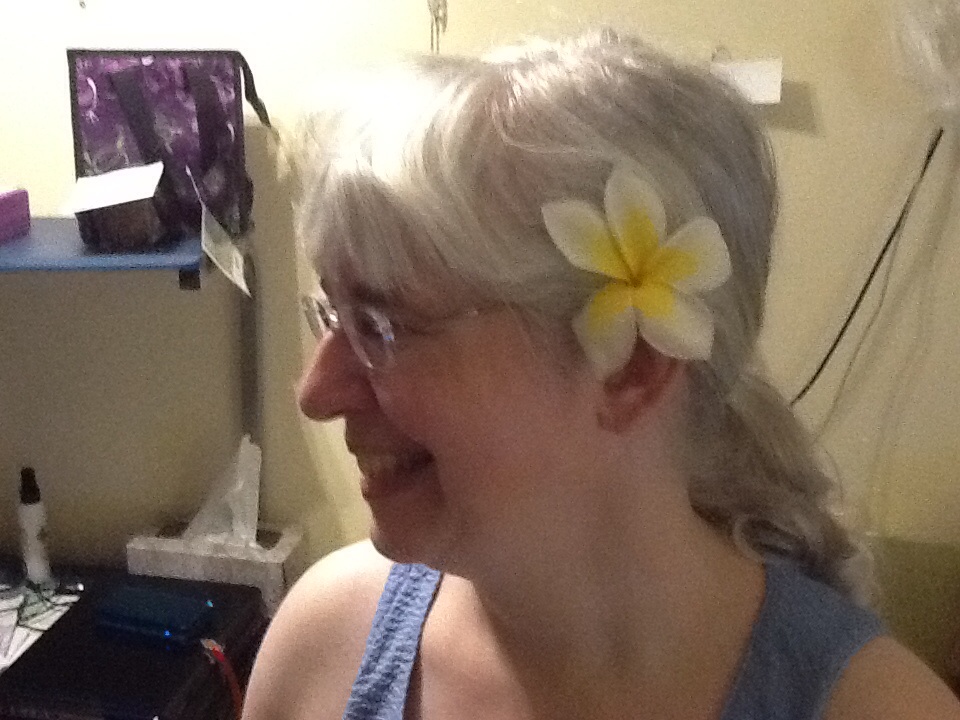

Yay! I think it worked!
Share this:

Byodo-In Temple
Yesterday, Beth took us to the Byodo-In Temple in Kahaluu, north of Honolulu. It was finished in 1968 to commemorate the 100th anniversary of the arrival of the first Japanese immigrants to Hawai’i. Located in a multi-denominational memorial park, it was modeled on the 900+ year old temple in Uji, Japan. You can read more about it here.
Before entering, Beth and Trinity together rang the large bon-sho (sacred bell) to create the proper mood for meditation. Next, we went to the meditation pavilion, which is set among little waterfalls and beautiful plantings. The temple grounds are non-denominational and it was nice to have a quiet space for the many prayer requests that are on my mind among family and friends. To enter the temple proper, we removed our shoes in order to visit the golden Amida Bhudda.
Then, we progressed to the other side of the grounds, which had ponds filled with carp. We also saw resident turtles and black swans. On shore, a large peacock was strutting about. There were sign warning that peacocks are not tame and should not be approached. Brent spotted the peahen off near some bamboo plantings at the edge of a clearing. With her were three young peachicks, who were so well camouflaged that we could not spot them unless they were moving.
I have never been to Japan, so I’m grateful that a piece of Japanese heritage is so beautifully re-created on O’ahu.
Share this:

The Bishop Museum
We spent the day at the Bernice Pauahi Bishop Museum in Honolulu. We had never been there before and were glad we decided to visit.
It is chock-full of artifacts, reproductions, and information from all periods of Hawaiian history. I especially liked the textiles, leis, and feather-work. I appreciated learning how the Hawaiians used the phases of the moon to keep time, with a name for each night of the lunar cycle. The moon governed activities such as planting crops and fishing. Attached to Hawaiian Hall is Pacific Hall, which examines commonalities among the peoples of Oceania.
There was a calendar overflowing with presentations by staff members. We attended a talk about native plants and a fantastic storyteller, relating a long tale of one of Hawai’i’s many gods. We saw a planetarium show about how the Polynesians used the stars to navigate, along with winds, currents, and birds, to find their way among the tiny islands in the vast Pacific. Brent and I went to a lava demonstration, where we got to hold various kinds of lava rocks, including the incredibly dense pillow lava from a deep underwater volcano, and see lava pour from a 2,000 degree furnace.
I even had a typical Hawaiian lunch at the museum’s cafe, featuring kalua pork and cabbage.
There was more to see than time allowed. I hope we will be able to visit again when we come back in the future.

 Joanne Corey