I was very moved by Nina Gaby’s guest post on Sarah Cushman’s blog and wanted to share with others:
http://susancushman.com/mental-health-monday-guest-post-comments-on-our-broken-system/

I was very moved by Nina Gaby’s guest post on Sarah Cushman’s blog and wanted to share with others:
http://susancushman.com/mental-health-monday-guest-post-comments-on-our-broken-system/

One of the happy side effects of having OM reblog one of my posts is that I get visits from other cool blogs, like this one, which I am now following.

I am happy to know that Sergeant Bowe Bergdahl, who has been the only US prisoner of war in Afghanistan for the past five years, is back in the hands of the United States armed forces. I’m glad that he will be returned to his relieved parents after he has recovered from his long imprisonment.
I am, however, dismayed by the people who are saying that he should not have been exchanged for five prisoners that the US had been holding in Guantanamo. Exchanging prisoners of war is a long-standing practice, especially near the end of the war, which is approaching quickly from the perspective of US involvement. The problem is that, due to the machinations of President George W. Bush’s administration, many people do not consider these five men as prisoners of war, instead categorizing them as”detainees” or “enemy combatants.” In this way, they have skirted international law about how prisoners of war are to be treated and blocked moves to release them or even bring them to trial. This shameful behavior has to stop. Prisoners of war have to be called prisoners of war and justly treated as such, in accord with international treaties to which the US is a signatory. Congress, having authorized the president to conduct the war, should not intervene as they have been doing in what is essentially a military matter to be handled by the chain of command up to the commander-in-chief.
The other issue that critics are lamenting is that the United States negotiated with terrorists. However, the exchange was negotiated through a third party, the government of Qatar. The US did not directly negotiate with the Taliban. The US did not release the prisoners to the Taliban. Again, we have a problem with words and with history. The war in Afghanistan was fought against the Taliban, which was the ruling party at the time, because they were sheltering Al-Qaeda. Al-Qaeda was the terrorist organization against which the US-led coalition was fighting; the Taliban was the ruling party of the country in which many Al-Qaeda members were hiding. The Taliban who became US prisoners were fighting for the government of Afghanistan; while it fits the narrative of critics of the current administration to portray them as terrorists now, it doesn’t fit the fact that these five men were part of the ruling government of Afghanistan, which should make them prisoners of war. Although the Taliban no longer rules Afghanistan, it doesn’t change the fact that they once did.
I am sorry that some people are marring what should be a time of relief and joy for Bowe’s family, his hometown in Idaho, and the country. It’s time for all of us in the United States to pull together and help heal the wounds of war. We owe it to those who have been deployed so long and so many times to celebrate their service to our country and find peace back home.

This June marks the end of an era for me. Since my older daughter began singing in the youth choir at church when she was in third grade, one or both of my daughters have been singing in choir, cantoring, and/or ringing handbells nearly all the years that they were living at home. With my younger daughter scheduled to move away to begin graduate school in August and no likelihood of her or her sister living in our hometown again, after this month, I will not hear them singing or ringing on a regular basis.
Of course, I have heard them sing in other places: elementary, middle, and high schools; Gettysburg College; Cornell University; even Carnegie Hall in NYC. I’ve heard my older daughter sing at her now home parish in Honolulu. My younger daughter is hoping to find a chorus in which to sing while she is in grad school, which is only about a 90 minute drive, definitely close enough for concert attendance.
I’ve actually extended the era of hearing them sing in our church longer than anticipated, with my younger daughter living at home for two years while doing volunteer work and preparing for grad school, affording her the opportunity to sing for the first time with an adult, rather than youth or teen, church choir, and to join the new handbell choir at our current parish. She and her sister had both rung in the parish where they were baptized, which is now closed; she had missed ringing, so the new bell choir was a tremendous blessing for her personally, as well as for the parish.
While I don’t foresee a circumstance where our daughters would live here, it is possible that at some future point – after we are retired, perhaps – we might live near one or both of them and again get to hear their voices raised in song at church on a regular basis. I don’t know what the future holds, but I will try to cherish these last few times, hearing my daughter ring and sing, helping us all to lift our hearts and minds to God in prayer.

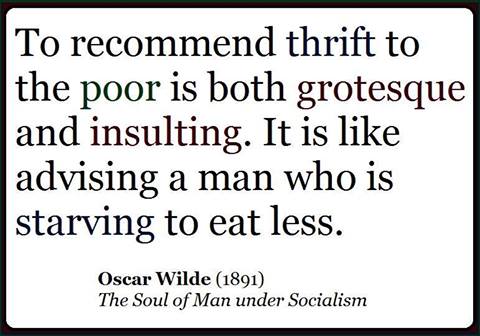
This is from an Austrailian blogger whom I follow. The Wilde quote applies across many times and places, including now in the US with rising poverty and income inequality while rich individuals and corporations don’t pay their fair share in taxes and receive subsidies and other tax breaks. Meanwhile, cuts are made to needed assistance for housing, food, education, and other services for the low- and middle-income folks.
 Thank you to Asylum Seeker Resource Center here in Australia for this quote.
I find it apt considering the circumstances surrounding the current budget and even more so considering the resources you provide that should be provided by our government. So thank you for this quote and thank you for the work that you do.

Today, I accompanied my daughter to the wedding of one of her middle/high school friends. The weather was beautiful. The setting, in a stone and wood pavillion overlooking part of a state park in the Finger Lakes, was lovely. The bride and groom were glowing, just as you would expect with a young bride and groom.
What was different was the ceremony, which was Wiccan. Having never been to a Wiccan ceremony, I was curious about how it would unfold. Wicca is a nature-based religion, so the ceremony included elements of nature. There was a lot of focus on the symbolism and blessing of the rings. The rings were blessed with earth, fire, water, and air, each of which also represented one of the four directions. The vows focused on mutual love and care, as the rings were exchanged. The final element of the ceremony was a literal tying of the knot, as woven cords representing the two families of origin were draped around the hands of the couple and tied to symbolize their union.
During the couple’s first dance, a mother sparrow flew into the pavillion with food in her beak. She alighted only a few feet away from where they were dancing, remaining there for about thirty seconds, before flying up to the rafters and over to her hungry chicks in a nest hidden in the base of a lighting fixture. Another blessing from nature.

Here we are again. The top news story is about yet another mass shooting in the United States, this time in Isla Vista, California. Sadly, it seems appropriate to re-post this entry from April 3, 2014, which couples the country’s problem with mass shootings by deranged persons with the aftermath of a local mass shooting.
***** ***** ***** ***** ***** ***** ***** ***** ***** ***** ***** ***** ***** ***** ***** *****
Last night, when the news broke about the shooting at Fort Hood, the first thought many people had was “not again.” Not again at Fort Hood, and not again in general.
The timing was especially poignant for those of us in the Binghamton NY area, because today marks the fifth anniversary of the American Civic Association shootings, in which fourteen people died, including the mentally ill gunman, and four were wounded.
Despite the tragic loss of life, the ACA shooting is usually not present in the list of mass shootings that gets recited in the media when the next horrible shooting comes along. Columbine. Virginia Tech. Aurora. Newtown. Fort Hood.
I am not saying that we should not be remembering these other mass shootings. We should, and we should be doing more to avert similar deaths and injuries in the future.
What I do find disturbing is that so many have forgotten about the ACA tragedy. I’ve spent a lot of time trying to figure out why.
I am afraid that the primary reason is that the gunman and most of the dead were immigrants. Most of them were gathered in one of the American Civic Association’s classrooms, taking a class to improve their English skills, when they were shot. They were from Vietnam, China, Pakistan, Iraq, Haiti, Brazil, The Philippines. Two were in Binghamton as visiting scholars. Others had been resettled in the area as refugees. The ACA is well-known in the area as a gathering place for immigrants to study English or prepare for citizenship tests. Several of those who were shot were employees or volunteers who had embraced this important mission. Somehow, though nearly all of us in the United States are descended from immigrants or are immigrants ourselves, the story of the ACA shootings did not embed itself into our minds as have some of the other tragedies that took place in schools or other public settings. I’m sorry to say that I think people see themselves or their grand/children as being just like those gathered in an elementary school or at a movie theater, but that they don’t see themselves as people from a different country, with a different skin color, speaking with an accent, working toward citizenship.
Five years on, I don’t want these people to have been forgotten. I want them to be remembered – and to be remembered as neighbors, as members of our community, as people like us.

I appreciated this post. I was particularly amused by number eight.
JC


One of the blogs I follow has issued this opportunity for reblogging opinion posts. Read his post and see if you want to take up the challenge.
JC

Today, across New York State, voters are heading to the polls for school district elections. For some reason I have never been able to ascertain, school budgets are the only ones that are voted on directly in New York. Unfortunately, sometimes this means that school budgets fail as a general statement against taxes, forcing second votes on revised budgets or austerity budgets that cut all extracurriculars and all-but-bare-bones transportation.
This year, there has been an unusual amount of advertising to pass the school budget. I think it is to convince people not to use the budget vote as an opportunity to take out their frustration with the contentious rollout of common core standards in the state. For the record, I no longer have school-aged children in my household, so I haven’t experienced common core directly in my family. I do support the concept of common core, to cover fewer topics in a school year, but in greater depth, in contrast to the current trend toward a mile wide but an inch deep approach. New York State’s curriculum has long been infected with survey-itis. For example, in the social studies curriculum, a survey of US history is taught in fifth grade, again as a two-year sequence in seventh and eighth grades, and then again as a one year Regents course in high school, locally usually taken in 11th grade. Because so much time is devoted to rushing through large amounts of material, there isn’t time to engage in in-depth analysis of any time period or theme. When I was in high school in Massachusetts several decades ago, we had options for semester-long US history courses in Civil War and Reconstruction, Minorities in America, Presidential Greatness, or several other options. Already expected to have an overview of our country’s history, we were able to develop deeper understanding of the hows and whys of history, which also helped to inform our lives as active citizens.
The upset over the implementation of common core seems to mirror two statewide changes that happened during my children’s school careers, the ending of local high school diplomas in favor of more rigorous Regents diplomas for all graduates and reform of state-wide tests in fourth and eighth grades and high school Regent exams. It also mirrors the transition to a new high school honors program on the local level. The root of the problems with all these changes was not that the final goals, but the transition itself, in which students are tested in the new framework without the benefit of the years of preparatory study that is in place when the transition is complete, resulting in lower test scores as these students catch up to the new standards. It seems that the same mechanism is happening with the transition to common core.
The other oddity of this election locally is that we have eight candidates running for four board of education seats. Given that candidates often run unopposed or with only one more candidate than seats available, this year is a hot contest. Even more unusual, there is a group of four being presented almost as a slate, advertised together in mailings, on yard signs, and in hand-delivered fliers, and endorsed by the local teachers’ union.
Voting is from 12-9 PM today at the local elementary schools. It will be interesting to see how this all turns out.
UPDATE: The budget passed by a wide margin. All four of the candidates endorsed by the teachers’ union were elected; the two incumbents who were running for re-election got only 50-60% of the voting totals of the successful candidates.



 Joanne Corey