One-Liner Wed. II: Galway Kinnell

“To me, poetry is somebody standing up, so to speak, and saying, with as little concealment as possible, what it is for him or her to be on earth at this moment.”
– Galway Kinnell, American poet, who died yesterday at the age of 87

Join in with Linda’s One-Liner Wednesdays!  Learn more here:  http://lindaghill.com/2014/10/29/one-liner-wednesday-eh/

One-Liner Wednesday: Voting

“Voting is a civic sacrament.”
– Father Ted Hesburgh

(Apologies for being US-centric in the timing of this, but, given that the vast majority of people reading this live in democracies, voting will be pertinent at some point in the year.)

Join us for Linda’s One-Liner Wednesdays! http://lindaghill.com/2014/10/29/one-liner-wednesday-eh/

Dear Governor Cuomo

IMG_0083

I sent this letter to New York Governor Cuomo today on the election and shale drilling and equal protection and climate change and science and more.  I know it is overly long – although I could have written much, much more – but I am proud that I managed to get this done before the election, despite the disruption that recent family health issues have caused. I decided to write this today, even though I have 385 email messages to view, so apologies to anyone awaiting a personal email.
JC

Dear Governor Cuomo,

The election is eight days from today, but I do not think I will be able to vote for you because you are not doing enough to protect the health and safety of all New Yorkers equally.

I live in Vestal and I and my Southern Tier neighbors are at risk from the health and environmental impacts of shale gas production, processing, transport, and waste disposal, a risk from which you have not protected us.

Some of the impacts that have already occurred are road damage in Vestal from the overweight trucks transporting drilling supplies to sites in Pennsylvania, inability to get mortgages on leased land, crime associated with gas industry workers staying on the NY side of the border, leaking pipelines, increased truck traffic, light and noise pollution, airborne silica sand along rail lines and during trucking transfers, and an explosion at a Windsor compressor station.

Other impacts are probable but not being tested, such as degradation in air quality.  Some impacts are obscured by the lack of tracking of the fossil fuel industry.  For example, waste products are shipped by truck without the exact composition being known, so that if they are disposed of at a landfill the effects on the leachate are unknowable.  Given that some of this leachate is treated in Endicott, this is a local concern as well as a regional one.  Meanwhile, it is still legal to spread drilling wastewater on roadways in New York, despite the fact that we know that Marcellus wastewater is often high in radium, which is a radioactive, toxic element known to bio-accumulate and cause serious health problems, including cancer.

Other impacts are, of course, global in scope.  The latest readings of atmospheric carbon dioxide are at record highs and we know that humans burning fossil fuels have been the driving force in that.  Also, the atmospheric methane level is at a record high.  Methane is a much more potent greenhouse gas than carbon dioxide, 86 times more potent in a twenty year timeframe. After a long period of stability, atmospheric methane levels began rising in 2007, coinciding with “shale boom.”  Several new scientific studies say that replacing coal or diesel fuel with fossil methane will not help our climate situation.  Shale development will not cut the risk of the next record flood here in Vestal or the next superstorm roaring up the Atlantic coast.

I have been trying to follow the DEC’s SGEIS and regulatory process for years now.  I say “trying” because the process itself is obscure.  Besides the obvious problem of the Minerals division trying to promote fossil fuel production while also trying to regulate it, there is the larger problem that the DEC’s work has been hidden from the public for years now. Because there has been a large number of independent, peer-reviewed scientific research studies published in the last two years, the last publicly available draft of the SGEIS is totally outdated, but we have no idea whether or not the DEC has been continuing to update the SGEIS as these new scientific studies and data from other states who are drilling have become available.

The obscurity of the process has been compounded by the DOH “review” of the the health findings of the DEC’s work.  Although this has been referred to as a study, it is not.  A real health study would follow the national/international guidelines of a health impact assessment (HIA) and would be conducted as a clearly defined, public process. It would consider health impacts on different groups of people, such as children, the elderly, and pregnant women/infants. It would look at the interplay of exposures to many different substances and the interactions among them. It would look at impacts for those in close proximity to wells and related infrastructure and those further away, including air quality, possible food and water exposures, and climate impacts.  It would also consider socioeconomic changes, such as rates of crime and homelessness, property value, cost of living, stresses on community services, and gains and losses in different job categories.

The economic section of the draft SGEIS is particularly outdated and unrealistic, having been built on what we now know are totally impossible expectations, that the industry could get economically viable amounts of gas anywhere in the Marcellus and Utica.  The price of methane is so low that it is unlikely anywhere in New York can presently produce shale gas economically, with the danger that small companies would take that risk using borrowed money and leave behind wells that cause pollution that the state would need to clean up when the company goes bankrupt.  New York already has thousands of leaking, abandoned wells awaiting proper plugging; we should not compound the problem with even limited amounts of shale drilling.

Governor, you say over and over that the science must decide, but that you are not a scientist. You say that scientists disagree.  The actuality is that industry-funded science is presented and used in a way that makes it seem that shale drilling is safe, while independent science presents data and possible explanations for that data which show that there are environmental and health impacts occuring. A recent example of this is the media coverage of a recent federal Department of Energy study of a single PA deep shale well for eighteen months, which showed that fracking chemicals had not reached an aquifer 3,000 feet distant, which is being touted as “proof” that “fracking” doesn’t pollute water.  Meanwhile, a PNAS study of the official DEP records of PA wells drilled from 2000-12 which covers tens of thousands of wells and their failure rates (Abstract here: http://psehealthyenergy.org/site/view/1217 with link to full report) shows that leakage rates for new shale wells in Northeastern PA are significantly higher than those for conventional wells and for shale wells drilled in the rest of the state. Leaking wells equals methane migration into groundwater, soils, and/or through faults, wellbores, or cracks equals pollution of the water, land, air, and atmosphere. The fact that NE PA is particularly vulnerable to leaking shale wells is disturbing for those of us in the border area of New York as the Marcellus geology here is similar. Yet this much larger study is not getting the press attention of the DOE study which is much less helpful in assessing the situation in New York.

The situation is sadly reminiscent of the doctors and scientists in the employ of the tobacco industry who swore to Congress that smoking did not cause cancer, while independent doctors and scientists were raising public health alarms not only about smokers’ health but also about those exposed to second-hand smoke or in utero tobacco exposure.

For you or any governor to authorize shale gas drilling in the Southern Tier would be like deciding to lift the smoking ban here while continuing to protect other parts of the state.  Our health and well-being here in Vestal is every bit as important as your health in Albany or the health of my sister in NYC or my daughter at ESF in Syracuse.  With the current scientific literature, there is no way that the DEC and DOH can say that unconventional shale gas drilling and its attendant processes are safe. We in the Southern Tier are due protection from its risks equal to those in other regions.

Your television ads tout “Next-Gen energy” here in Broome County and we are justifiably proud of that. Do not compromise that pride by also saddling us with the outmoded 19th and 20th century fossil fuel dependence that is worsening global warming. It’s time to back up your rhetoric after Sandy about combating climate change with action.  NO to new fossil fuel development and infrastructure!  YES to renewable energy, clean energy storage, and energy efficiency initiatives!  YES to equal health and environmental protection for everyone!

Sincerely,
Joanne Corey

SoCS: two degrees

Two degrees Celsius is the threshold between what is considered impactful but manageable global warming and catastrophic global warming. Climate scientists will tell you it isn’t that clearcut. We are already seeing major impacts at only one degree-ish. At two degrees, we may get major feedback loops happening, like the melting of permafrost and the release of methane hydrates from northern seas and oceans which would accelerate warming further.

Two degrees C. has been translated into 350 ppm carbon dioxide. We have now topped 400 at times in the atmospheric readings on the Big Island of Hawai’i – I think it is Mauna Kea, but it could be Mauna Loa – and the levels keep rising.

What is disturbing me even more is that global atmospheric methane, after a long period of stability, began rising in 2007. Methane is more short-lived in the atmosphere than carbon dioxide, but is a much more powerful greenhouse gas – 86 times more powerful in a twenty year context and 106 times more powerful in a decade. Given that our timeframe to get global warming under control is now very short, methane in the atmosphere is particularly troubling as it has such a strong effect in the immediate future.

So, why do I hear the word degrees and immediately go into my global warming spiel?  I write about this a lot, as an offshoot of my commentary on the dangers of shale oil/gas aka unconventional fossil fuels aka fracking.  I have spent countless hours writing and researching and commenting on these topics.  It started as a personal thing as my state, New York, is currently under a moratorium, while our neighbor state Pennsylvania is drilling extensively. And I live in a border town.

I could literally write about this for hours, but I will spare you. I apologize if I was unclear at all in this post. It’s the whole stream of consciousness thing – no fact-checking or editing allowed…

This is part of Linda’s Stream of Consciousness Saturdays.  This week’s prompt was “degree/degrees.”  Join us! Read how here:  http://lindaghill.com/2014/10/24/the-friday-reminder-and-prompt-for-socs-october-2514/


Badge by Doobster @Mindful Digressions

Visiting chapel and Beth’s tree

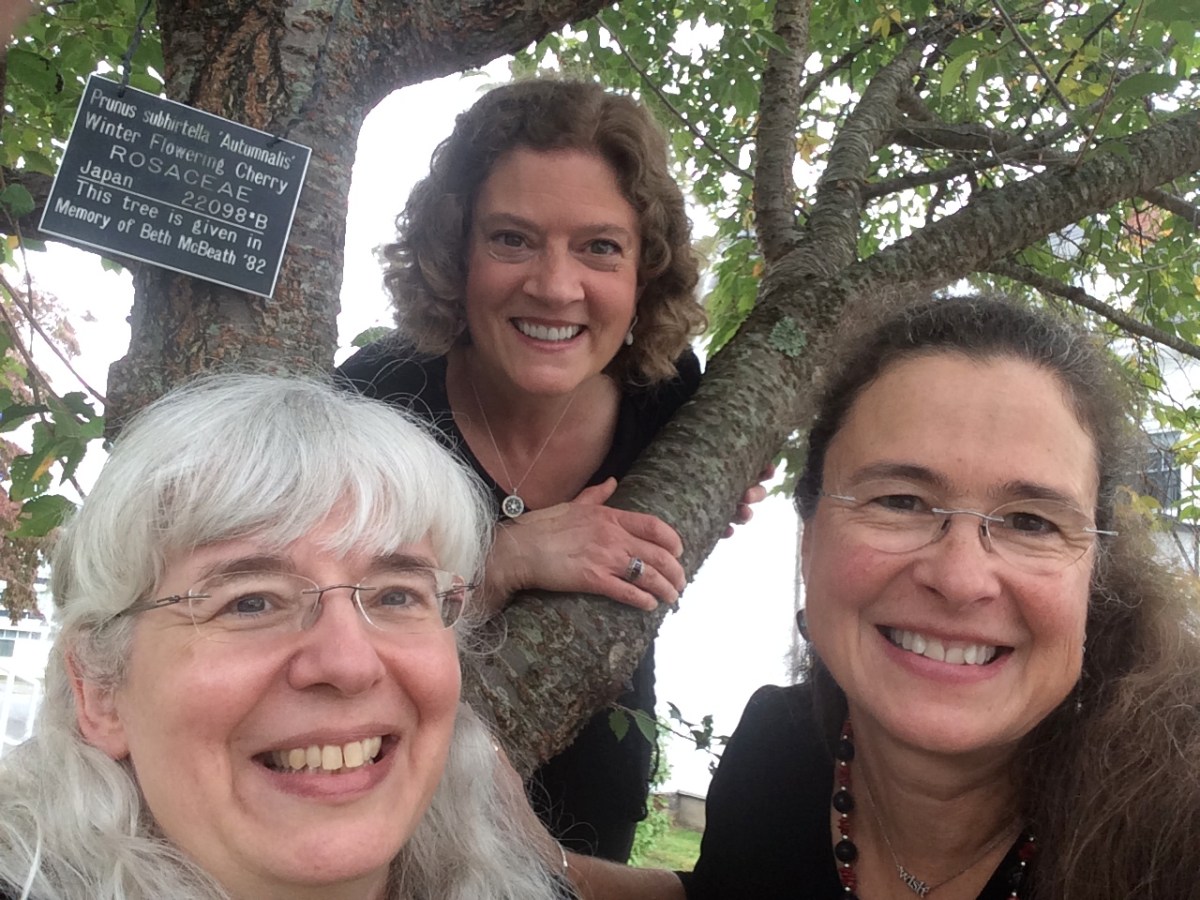
Mary, Tricia, and I with Beth's tree next to Helen Hills Hills Chapel, Smith College
Mary, Tricia, and I with Beth’s tree next to Helen Hills Hills Chapel, Smith College

After the Alice Parker concert at Sage Hall, Mary, Tricia and I proceeded up the hill near Paradise Pond to Helen Hills Hills Chapel.

Our first priority was to visit the winter-flowering cherry tree planted beside the chapel that is dedicated to the memory of Beth McBeath, another class of ’82 Glee Club member, who died as the result of an airplane fire during October break of our senior year.  Her funeral was held at the chapel and Glee Club sang Bach’s setting of “Jesu, Joy of Man’s Desiring” through our tears during the service.  Later, I attended the planting of the memorial tree, although the tree in the photo is not the original tree but a replacement for the one we planted that day, a weeping cherry that was unrecoverably damaged in an ice storm years later.

Beth was a light-filled, infectiously joyous person. She served the Ecumenical Christian Church (ECC) at Smith as a deacon and liturgist.  She participated in the Smith choral program in all her years there, serving as an officer as well as lending her alto voice to our choirs.  In the best tradition of the liberal arts, she studied with both breadth and depth, including taking a course in the art department on bookmaking.  She was always friendly and interested in other people.  Like me, as we entered our senior year, she was engaged to be married.

Her loss, along with another classmate who died from lung cancer later in our senior year, taught us not to take time for granted.  Her memorial tree is something that I try to visit every time I get back to campus. I make donations to the Smith Fund in her memory, which puts me in touch with her mom, who still survives.  Mary sent the photo, which we took with her phone, to Beth’s mom.  I hope it made her smile.

After visiting the tree, we went into the chapel.  None of us had seen it since the pews were removed, although we had seen a photo in the Smith Alumnae Quarterly.  Despite that, it still was a bit of a shock to walk through the front doors of the chapel, which was modeled after a traditional New England Congregational style church, and not see the rows of white-painted wooden pews with the red center aisle carpet down which I had walked as a June bride a few weeks after our commencement.  Instead, there were heavy, boxy wooden chairs, arranged in circles over a wood floor.  Given that there are no longer regular worship services in the chapel, a fact that still makes me sad, I do understand the impetus to remove the pews to make the space more versatile for concerts and other events, but I wish that the wood floor had been a traditional New England hardwood and the chairs had been more elegant and in keeping the architecture.

Still it was better than the last time I had visited chapel in May 2012, when I wrote this poem that touches on both the chapel and Beth’s tree. chapel at reunion  (Sorry for the pdf embedding, but I didn’t have time to fiddle with the editing settings to get the indents and spacing to work correctly.)

After walking through the main body of the chapel, we went upstairs to the gallery and visited the organ, which was a memorial gift in honor of Helen Hills Hills’ husband James. I spent so many hours on that bench, practicing, having lessons, accompanying for Choir Alpha, playing for Mass, prepping for my junior recital with Mary and Natalie, preparing for and playing preludes or postludes for ECC services, and additional hours standing beside the bench turning pages for other organists.  It’s moments like this when it feels odd that I haven’t played for years…

We also walked to the basement where the offices are. Almost every room has a different occupant or purpose than when we were there.  I thought about the series of Marc Chagall prints that used to hang in the hallway.  I think the art museum took custody of them so that they are in a better protected environment, but it used to be so cool to have original artworks in an everyday space. The Bodman Lounge is still there, with shelves of spiritual and religious books and couches and comfy chairs.  Mary had given me a bridal shower there and it was the room in which I dressed for my wedding.

I felt reluctant to leave. Even with all the changes, the richness of the memories will always draw me back.

doing and being

Among the things I have done so far this week:
* cooked healthy meals and a not-quite-as-healthy gingerbread bundt cake that smells and tastes amazing
* tackled the backlog of physical mail – the email/social media backlog, not so much
* gone to the doctor’s office for diagnosis of an MCL strain in my knee and started daily exercises to address it
* made a series of phone calls to help arrange for occupational therapy for my mother-in-law in her home, as she continues to recover from her collapsed vertebra
* visited in person and/or by phone/skype with her, with my parents, and with both daughters
* run errands for our house and for my mother-in-law
* facilitated the spirituality group at my church, which is studying Richard Rohr’s Immortal Diamond
* raked leaves
* wrote comments about fracking
* did laundry
* attended poetry workshop
* talked with B. about his work, the news, his mom, etc.

But, as Richard Rohr and so many other spiritual teachers tell us, we are human be-ings, not human do-ings.

We are loved and valued for who we are. I am fortunate right now that I am able to be active and to do things, but the do-ings are important only because they are expressions of love and care – love for family expressed through caretaking but to an even greater degree by spending time with them, caring for my own body, caring for creation, honoring artistic expression of myself and others, connecting with God and reflecting on spiritual matters in community.  This is expressing who I am. This is what is important.

One-Liner Wednesday: Julia makes it sound simple.

“Find something you’re passionate about and keep tremendously interested in it.”
– Julia Child

Please join in Linda’s One-Liner Wednesdays! Details here:  http://lindaghill.com/2014/10/22/one-liner-wednesday-one-filament-short-of-a-lightbulb/

Hello, Ello!

I am now on Ello as joannecorey so if anyone is so inclined, follow me and I will follow you back.  I’m just learning my way around but am interested in participating with this new, ad-free platform.

Mind? What mind?

The top of JC's mind, or at least, the top of JC's head
The top of JC’s mind, or at least, the top of JC’s head

I’m up in the middle of the night again. Theoretically, I could write a post from the backlog of things I have queued in my head or draft folder, but I don’t have enough sustained focus to do so. Instead, what follows will be (part of) the swirl that constitutes the “top” of my mind at the moment.

* I wonder if I will get my pre-election open letter to Governor Cuomo written before the election. It would be about the fracking moratorium, of course, the emerging science, the threat we feel here of being a sacrifice zone, the need to chuck the current outdated and corrupt draft SGEIS, etc.

* Ebola.  Seriously, people in the US, get a grip!  Other than a few dozen people, your chance of exposure to ebola is non-existent.  If you want to do something useful for your health, get a flu shot – and catch up on any other immunization you might need.  Millions of people have died from flu complications around the world over the years.  It is easy to catch and transmit. Flu vaccine works partly by having lots of people immunized, creating herd immunity to help protect people who can’t be immunized and the percentage of people who will develop flu despite being immunized, who will generally have milder cases because they were immunized than if they had not been.

* So much war and violence.  I don’t actually know if I could write a post about this.  People are – and should be – so much better than this by now.

* The confusing muddle of the synod of the family and evangelization, which will be continuing at least for another year.

* The comfort that the beauty of a glorious Northeast foliage season has been in these past few weeks of dashing about on caretaking duty.

* The rest of my planned follow-up to Smith Alumnae Chorus event posts.

* More chapters to My (Feminist) Story.

* Poetry, which is the one thing I have committed to making progress on, despite the swirl going on in my head.  Truthfully, I’m not doing everything I had intended to with it, but I have made all three meetings of the poetry critique group I have joined and where I have found welcome, help, and acceptance, begun the five-week fall semester of Binghamton Poetry Project, and may even attend, though probably not read at, my first ever open mic next week.  I don’t have the time to do the research I need to figure out submissions, I owe a thoughtful email to a poet friend, and I wish that I had time/brain to write and edit more, but I am giving myself a pat on the back for making some progress.

* At some point, I really will get some of my Hawai’i photos – from May! – in shape to post FB albums and to re-post blog entries with some photos added.  I hope to do this before our next visit to the Islands…

* Spiritual matters.  There is so much going on  – experiences with our elder and younger generations, a recent parish mission, studying Richard Rohr’s Immortal Diamond, missing contact with my spiritual mentor/companion and other friends with whom I can share soul-conversation.

* An update to my empty nest post.  Something along the lines of when the sandwich generation goes open-face…

Maybe I should attempt some more sleep before dawn.  Or attack the mounds of mail that arrived this week…  At least I attended vigil Mass yesterday so I don’t need to drive about and try to be attentive for church this morning.  And B. promised to make us a nice Sunday breakfast this morning.

SoCS: sad shape

It’s actually Friday and I just read the prompt which is the word “shape”.  I figured I needed to write now, because my time is very unpredictable these days, so here we go.

My mother-in-law is in sad shape. I don’t know if that is a term that people are using now or not. I remember hearing it when I was growing up.

A backache she woke up with on Sept. 7 tuned out to be from a compression fracture of her L1 vertebra. By the time we got to the neurosurgeon and they did an MRI, the vertebra had collapsed. She spent two days in the hospital in order to have a procedure where they inject bone cement to stabilize the bone fragments. If the procedure had been done when it was still a compression fracture, they would have put balloons in and injected the cement to stabilize and shore up that vertebra, but once it is collapsed, it isn’t possible to retain the function. Also, the chance for fast pain relief would have been much better.

As it is, progress is very slow. She is on strong pain meds and does best when she is lying down, except that she needs to be up and about to get stronger so that she can start physical therapy and build her core muscles and leg muscles so that she can function and perform daily tasks.  Unfortunately, she didn’t have a big appetite before and this has reduced her to not having an appetite at all, so she has lost weight. It’s all turned into a muddle of meds and side effects and one thing making another thing harder to do.

As you might expect, my spouse and I have been up there a lot and have been bringing her to appointments and running errands and talking to the health professionals and trying to get her to eat and helping with laundry and bringing in the mail and so forth.

This afternoon, I kind of hit the wall. I can’t tell the whole story – privacy and such – but I do think that I may finally have gotten her to realize that she has to be the one to actually make up her mind to get better.  She has to stop saying “I know I need to eat and drink more” and actually do it, instead of making excuses. If she doesn’t, she isn’t going to maintain her weight, much less gain what she needs to. She has to want to get stronger and make up her mind to do it, instead of putting energy into self-pity.

We can’t do this for her. She has to do it for herself.

I am exhausted by it all and really wanted to have a good cry about it, but couldn’t quite manage it.  The eyes watering while cutting up some onions to make ham and scalloped potatoes for dinner doesn’t count.  Maybe later…

This post is part of Linda’s Stream of Consciousness Saturdays. Join us! Find out more about it here:  http://lindaghill.com/2014/10/17/the-friday-reminder-and-prompt-for-socs-october-1814/

socs-badge
Badge by Doobster @Mindful Digressions