
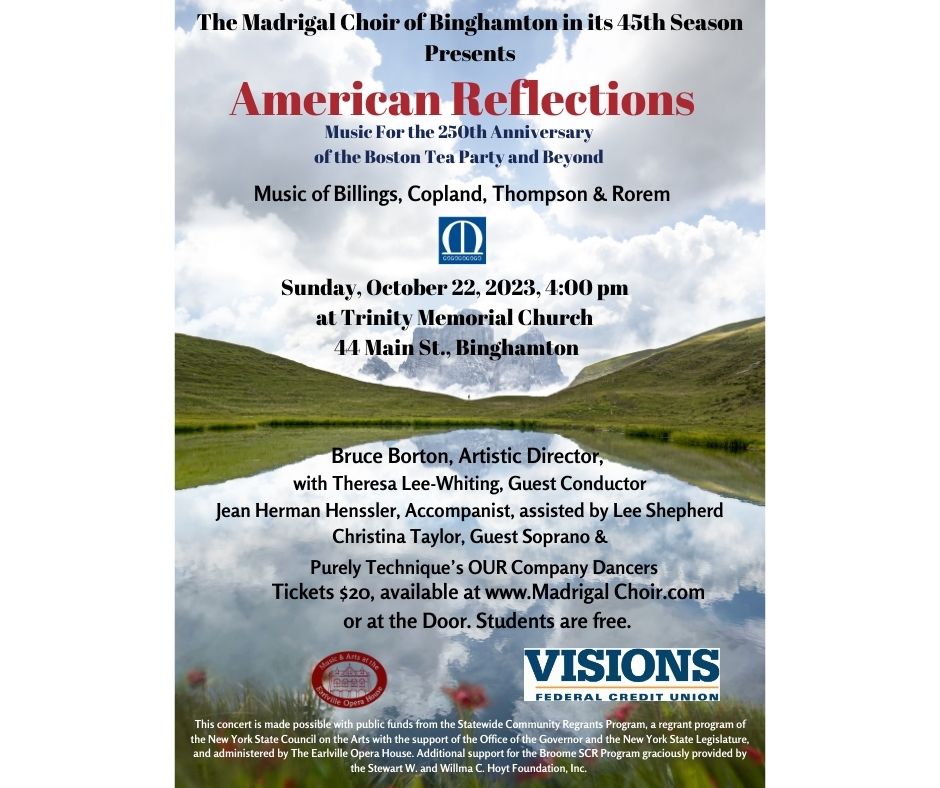
Yesterday, the Madrigal Choir of Binghamton presented the first concert of our 45th anniversary season, “American Reflections.”
Our artistic director, Bruce Borton, chose the program to commemorate a number of anniversaries. We sang a set of pieces by William Billings in commemoration of the 250th anniversary of the Boston Tea Party; Billings was a Boston resident at the time and two of the pieces we sang directly referenced the revolutionary period. Special guest soprano Christina Taylor sang four settings of Walt Whitman poems by Ned Rorem, in honor of Rorem’s centennial. We also sang Randall Thompson’s “The Testament of Freedom,” a setting of Thomas Jefferson texts composed in 1943 for the University of Virginia’s glee club commemorating the bicentennial of their founder Jefferson’s birth. We rounded out our all-American program with pieces from Aaron Copland’s opera, The Tender Land.
I’m pleased to say that the concert went well and was enthusiastically received by our audience. We owe our thanks to Theresa Lee-Whiting, who relinquished her role as singer and president of Madrigal Choir to serve as guest conductor for this concert after Dr. Borton needed to take medical leave. We were grateful that Dr. Borton was feeling well enough to attend the concert and hope that he was proud of the work we had done.
I admit that rehearsing and singing this program had its challenges from a historical perspective. For example, in “Stomp Your Foot” from The Tender Land, the text is very explicit about the devaluing of the work of “ladies” versus men. The story is set in the farmlands of the 1930s Depression era, so it is accurate for the times, if a bit galling to sing these days.
The more problematic text for me was Jefferson’s words in “The Testament of Freedom.” The bulk of the text Thompson chose to set is from the “Declaration of the Causes and Necessity of Taking Up Arms.” There are a number of references to bondage or slavery as a consequence of the colonists not taking up arms against the British. For example, “We cannot endure the infamy and guilt of resigning succeeding generations to that wretchedness which inevitably awaits them if we basely entail hereditary bondage upon them.” It’s difficult to sing the text with the knowledge that Jefferson was holding hundreds of men, women, and children in “hereditary bondage” as he wrote these words. He also writes that the colonists must take up arms “for the protection of our property, acquired solely by the honest industry of our forefathers and ourselves,” as though the work of those he enslaved was not also adding to his wealth, although he would have considered those people part of his property. I wonder if Thompson would have chosen the passages to set differently if more modern scholarship on the colonial and Revolutionary War times had been available to him in the 1940s.
Given that he was composing this work during World War II, the final movement, using text from a letter Jefferson wrote to John Adams in 1821, is poignant. “And even should the cloud of barbarism and despotism again obscure the science and liberties of Europe, this country remains to preserve and restore light and liberty to them…” Some of the young men premiering this work would have been about to enter the armed forces to fight in Europe or the Pacific theater. Both my and my spouse’s fathers were in the service during World War II eighty years ago. It was sobering for me to sing these words at a time when democracy is again assailed by authoritarian and fascist influences in Europe and here in the United States.
The fourth movement begins with these words from Jefferson to Adams, “I shall not die without a hope that light and liberty are on steady advance…” On July 4, 1826, both former presidents died on the 50th anniversary of the Declaration of Independence they both signed.
May light and liberty – and music – continue to advance.
Share this:


 Joanne Corey
In spite of the contextual issues, it sounds like it was an amazing experience!
LikeLiked by 1 person
It was! No time to rest on our laurels, though, as we start rehearsing on Sunday for Lessons and Carols performances the first weekend of December.
LikeLike